
The Director's Loan Account Trap: When Personal Spending Through Your Limited Company Comes Back to Bite
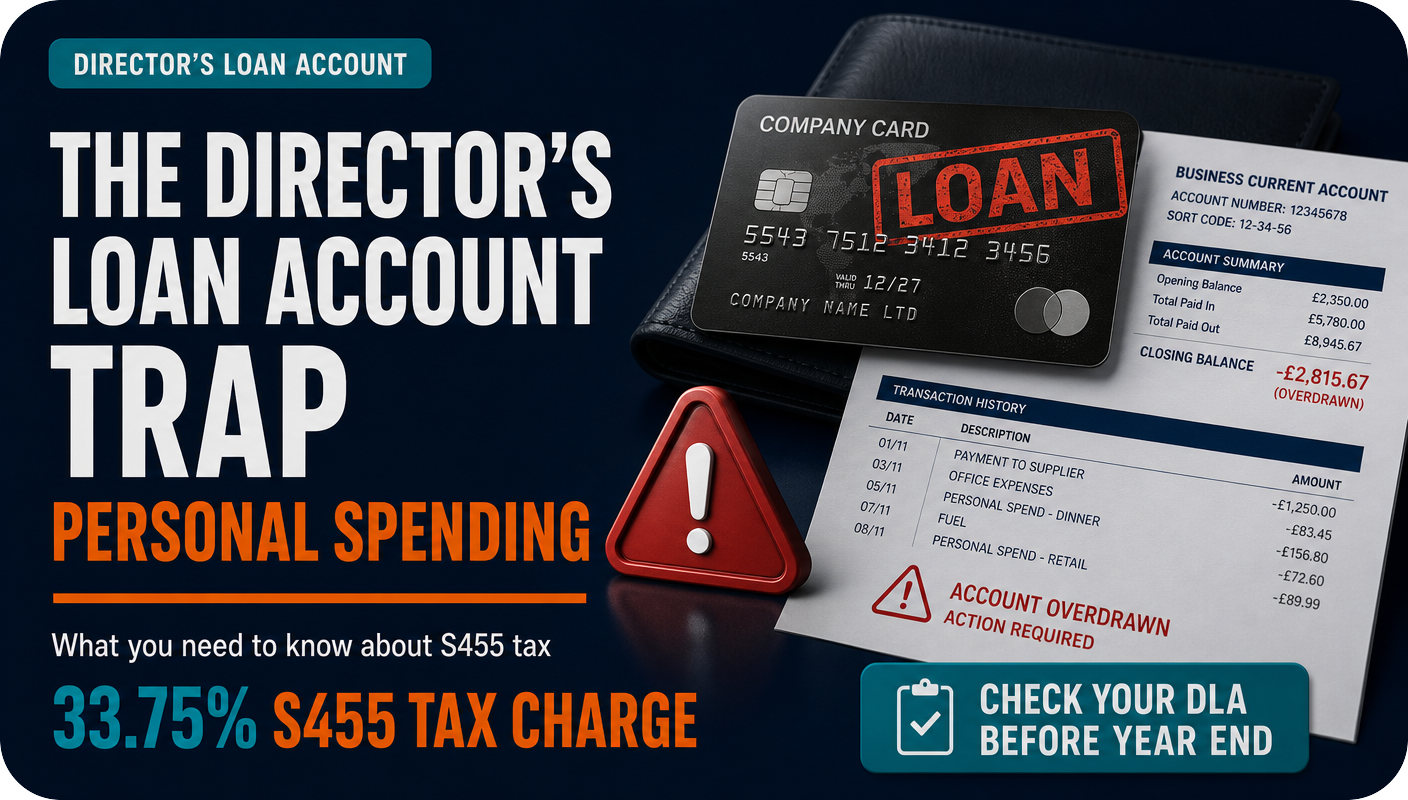
Using the company card for a personal purchase can feel harmless. A meal here. An Amazon order there. A family expense, a holiday payment, some personal shopping or perhaps a bill that happened to be paid from the company bank account. After all, it's your company and there's money in the bank. But this is where many limited company directors fall into what we call the Director's Loan Account (DLA) trap. The problem often doesn't become obvious until months later, when the accountant prepares the year-end accounts. All figures and rates in this article are correct as of 14 August 2026.
- Your limited company is a separate legal entity, so company money is not personal spending money.
- Personal purchases paid by the company can create an overdrawn Director's Loan Account.
- Clearing an overdrawn DLA through a dividend can create further personal dividend tax.
- Leaving a qualifying loan outstanding can trigger a Corporation Tax charge and other tax considerations.
- Keep records current and review your DLA regularly so problems are identified early.
That £10,000 or £20,000 you thought was simply “expenses through the business” may not actually be an allowable business expense at all. Instead, those transactions can end up sitting in your Director's Loan Account as money you owe back to your company. And clearing that balance can create a second problem: you may need to extract even more money from the company as dividends or remuneration, potentially creating an additional personal tax bill.
Here's how the trap happens.
First: Your Limited Company's Money Isn't Your Personal Money
One of the biggest mindset changes when moving from being a sole trader to operating through a limited company is understanding that the company is a separate legal entity.
Money sitting in the company's bank account therefore isn't simply your personal spending money.
There are legitimate ways of taking money from your company, including salary, dividends, repayment of money the company owes you and reimbursement of genuine business expenses.
The Personal Expense Problem
Imagine your company has a healthy bank balance.
Over the course of the year, you use the company debit or credit card for various purchases:
- £2,000 of personal meals and entertainment
- £3,000 of holidays and travel
- £4,000 of personal shopping
- £3,000 of household and other private costs
That's £12,000 spent through the company.
You may have been looking at your bookkeeping software throughout the year and assumed these were simply company expenses.
Then your accountant reviews everything at year end.
The bad news arrives: “These aren't allowable business expenses.”
Suddenly, that £12,000 hasn't disappeared into your company's expenses. It has potentially created a £12,000 Director's Loan Account balance.
In simple terms: You have spent £12,000 of the company's money personally, so you may now owe the company £12,000.
This Is Where the DLA Trap Really Starts
The obvious question is: “How do I clear it?”
One option is straightforward: repay the money personally.
But many directors don't have £12,000 sitting in their personal bank account ready to transfer back.
So another possibility, where appropriate, might be to clear or reduce the balance using a dividend.
But dividends aren't simply an accounting adjustment that can be created whenever required.
A company can only pay dividends when it has sufficient available profits, and dividends must be properly declared and documented.
HMRC also acknowledges that a Director's Loan Account may potentially be offset by declaring a dividend where the director is a shareholder and sufficient funds are available.
And here's the painful part.
That additional dividend may create additional personal dividend tax.
You have effectively created a tax problem from personal spending that you may not even have realised was building up.
A Simple Example
Let's say you've already taken the salary and dividends you intended to take for the year.
Then your accountant discovers £15,000 of personal expenditure sitting in the company's costs.
Those expenses are reclassified to your DLA.
Your Director's Loan Account is now £15,000 overdrawn.
You don't have £15,000 personally to repay it.
If the company has sufficient distributable reserves, one potential solution may be to declare a further dividend and credit it against the loan account.
But that additional dividend is still dividend income for you.
So although you may not receive another £15,000 into your bank account, you could end up with £15,000 of additional dividend income for tax purposes because the dividend has been used to clear money you've already spent.
That's the sting. You spent the money months ago. Now you're potentially paying the personal tax associated with extracting that money properly.
“Can't We Just Pay a Bonus Instead?”
Potentially, remuneration could be used in some circumstances, but that isn't a magic tax-free solution either.
Salary and bonuses are generally subject to PAYE and National Insurance rules. GOV.UK confirms that salary payments involve Income Tax and National Insurance, including employer National Insurance obligations for the company.
The correct treatment will depend on the circumstances, and transactions cannot simply be relabelled after the event without considering the relevant tax and accounting rules.
Either way, the important point is this: Personal spending through your company does not become tax-free just because you used the company card. Eventually, the bookkeeping has to explain where that money went.
What If You Just Leave the Director's Loan Outstanding?
There can also be benefit-in-kind implications for certain loans.
For example, HMRC states that some beneficial loans with a combined outstanding value below £10,000 throughout the whole tax year may be exempt from reporting and tax/National Insurance requirements. Once an overdrawn loan goes beyond the relevant conditions, additional rules need to be considered.
So an overdrawn DLA shouldn't simply be ignored until next year.
The £30,000 Wake-Up Call
Year 1: £8,000
Year 2: £11,000
Year 3: £11,000
Before long, the DLA could be £30,000 overdrawn.
The director may have believed the company was paying those expenses. In reality, they have effectively been borrowing money from their company.
Now imagine being told: “You need to repay £30,000 to the company.”
Most people can't.
So you then have to explore legitimate ways of dealing with that balance, potentially including dividends where sufficient distributable reserves exist, remuneration where appropriate, repayment by the director, or another solution based on the circumstances.
Some of those routes can create significant personal tax or National Insurance consequences.
That is why a DLA problem is much easier to prevent than repair.
Your Accountant Isn't “Disallowing” Expenses to Be Difficult
This is another common frustration.
A director sees £50,000 of transactions going through the business and expects £50,000 of expenses in the accounts.
The accountant then asks questions and reclassifies £10,000 as personal.
It can feel as though the accountant has suddenly increased the company's profit and created a Director's Loan Account problem.
But the underlying problem isn't the year-end adjustment. It's that personal expenditure has been mixed with company expenditure throughout the year.
The accountant is simply identifying the true nature of those transactions.
The Better Approach: Separate Business and Personal Spending
The easiest way to avoid the DLA trap is remarkably simple:
Treat your limited company as a separate business — because that's exactly what it is.
- Use the company bank account and company cards for genuine company expenditure.
- Use your personal account and personal cards for private expenditure.
- If you're unsure whether something can legitimately be paid by the company, ask your accountant or bookkeeper before spending the money, rather than discovering the answer nine months later.
- Keep your bookkeeping up to date.
If your books are reviewed monthly, personal transactions can be identified quickly and your DLA balance can be monitored throughout the year. Our Bookkeeping Services can help provide that regular visibility.
You then have time to make sensible decisions.
Waiting until the annual accounts are prepared can mean discovering the problem when there are far fewer options available.
Know Your DLA Balance Before Year End
Every limited company director should be able to ask: “What does my Director's Loan Account look like right now?”
Not once a year. Regularly.
If your DLA is moving towards an overdrawn position, that's an early warning sign that you may be extracting more from the company than you're formally taking through salary, dividends, legitimate expenses or repayment of money owed to you.
Catching that early can prevent an unpleasant conversation at year end. Our Limited Company Accounts service and pricing information are available if you would like ongoing support.
The Bottom Line
The company card isn't a personal credit card.
Every pound you take from your limited company eventually needs an explanation.
Was it:
- Salary?
- A dividend?
- A genuine business expense?
- Repayment of money owed to you?
- Or a Director's Loan?
If personal expenditure is regularly being put through the company, you could be quietly building an overdrawn Director's Loan Account without realising it.
Then, when your accountant reviews the accounts, those personal costs may be moved to your DLA.
You may need to repay the money. You may need additional dividends where legally available. You may need to consider remuneration. And any solution can have tax consequences of its own.
Don't wait until your year-end accounts to discover how much you owe your own company.
At 360 Accounts & Bookkeeping, we believe bookkeeping should give you visibility throughout the year — not unpleasant surprises after it has ended.
Keeping your bookkeeping current and monitoring your Director's Loan Account regularly means you can spot the problem early, understand how much you're actually taking from your company and make informed decisions before a manageable balance becomes an expensive tax problem.
Speak to 360 Accounts & Bookkeeping about keeping your books current and making informed decisions.
Book a call
Director's Loan Account Q&A
A Director's Loan Account records money moving between a director and their limited company that is not salary, dividends, reimbursement of genuine business expenses or repayment of money the company already owes the director. If you take company money personally, it may create an overdrawn DLA.
A personal purchase made on the company card does not automatically become a company expense. It will normally need to be identified and accounted for correctly, often by debiting it to your DLA unless it forms part of properly treated remuneration or another valid category.
Potentially, where you are a shareholder and the company has sufficient distributable profits. The dividend must be properly declared and documented. It is still dividend income for you and can create additional personal dividend tax, even where it is credited against money already spent.
It can create further tax complications. Where the detailed conditions apply and a shareholder-director's loan remains outstanding more than nine months after the end of the relevant Corporation Tax accounting period, the company may face an additional Corporation Tax charge. Benefit-in-kind rules may also need consideration for certain loans.
Not as a general permission to take £10,000 personally without consequences. HMRC states that some beneficial loans with a combined outstanding value below £10,000 throughout the whole tax year may be exempt from reporting and tax/National Insurance requirements. The relevant conditions and the treatment of the underlying transactions still matter.
Keep business and personal spending separate, use company cards only for genuine company expenditure, keep bookkeeping up to date and review your DLA regularly. Ask for advice before making a payment when you are unsure how it should be treated.