
Government £450m SME Red Tape Reduction, What Small Businesses Need to Know
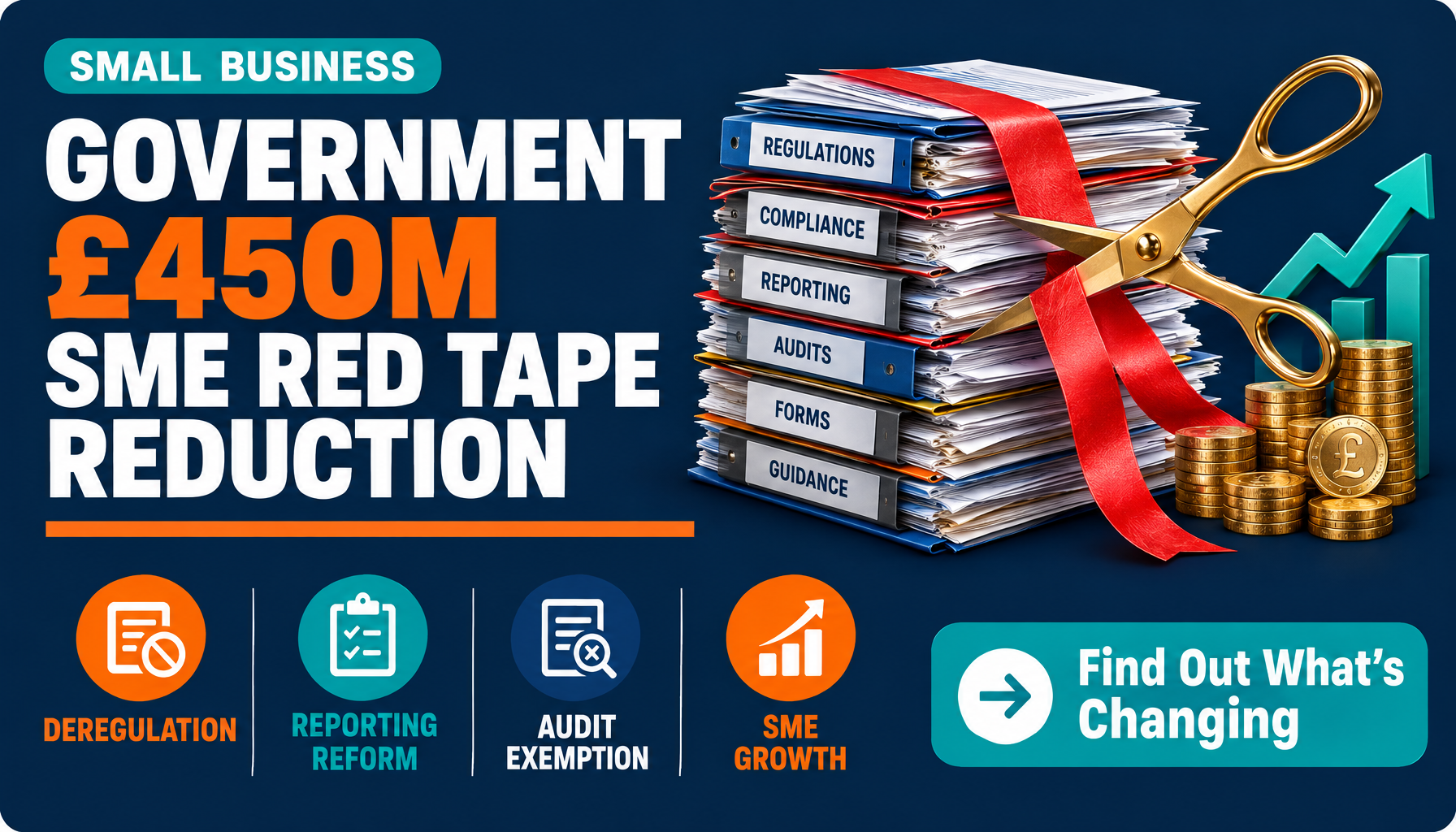
Government £450m SME Red Tape Reduction, What Small Businesses Need to Know
As of September 2026, the Government has confirmed a package of reforms designed to save UK businesses more than £450 million a year by stripping back outdated corporate reporting rules. For small businesses, sole traders and limited company directors across Surrey and beyond, this is one of the most significant deregulation announcements of the year, and it is worth understanding exactly what is changing, when, and what it means for your business.
Key Takeaways
- The Government has launched an overhaul of corporate reporting rules expected to save businesses over £450 million a year, as of September 2026.
- A public consultation opened on 7 September 2026 and closes on 30 November 2026, so the final rules are not yet locked in.
- Small and medium sized businesses will be exempt from certain reporting requirements entirely, including some director's reports and strategic reports.
- Some medium sized companies will become eligible for audit exemption, reducing annual accountancy and compliance costs.
- Electronic communication to shareholders will become the default, cutting paper based admin.
- Nothing changes immediately, but directors should start preparing now so they are ready when the rules land.
What has actually been announced
On 6 September 2026, the Department for Business, Innovation, Science and Trade confirmed plans to simplify corporate reporting law, building on earlier reforms that already save businesses over £450 million a year, with further savings expected once the new proposals are finalised. Business Secretary Jonathan Reynolds described the current system as “pen-pushing paperwork” that does nothing to help firms grow.
The scale of the problem is real. Research cited by Government shows the average annual report and accounts of some businesses now runs to around 98,000 words, longer than J. R. R. Tolkien's The Hobbit, with FTSE 100 companies averaging even more at roughly 152,000 words. For a small chain of cafes, a hotel group, or a family run manufacturer, complying with reporting rules built for large listed companies has simply become disproportionate.
What is changing for SMEs and Ltd companies
As of September 2026, the proposals under consultation include several changes directly relevant to owner managed businesses:
- Lighter reporting for SMEs, with a clearer distinction between what small and medium sized companies must report compared with large or listed companies.
- Wider audit exemption, allowing some medium sized companies to qualify for exemption from statutory audit, reducing annual accountancy costs.
- Scrapped director's reports and expanded exemption from strategic reports for qualifying companies, expected to save around £230 million a year on its own.
- Digital first shareholder communication, making electronic reporting the default instead of paper mailings.
- Simpler distributable profits rules, moving toward a solvency based regime rather than today's complex capital maintenance rules.
Why this matters for smaller businesses
Corporate reporting rules were originally designed with large, publicly listed companies in mind. Over time, many of the same obligations trickled down to smaller limited companies that never needed the same level of scrutiny. This reform is a deliberate attempt to separate the two, so that a small limited company in Guildford is not filling in paperwork built for a FTSE 100 business.
When will this happen
It is important to be clear that these are proposals, not yet law. As of September 2026, the consultation opened on 7 September 2026 and runs until 30 November 2026. After that, Government will review responses before confirming final rules and a timetable for implementation. In practice, this means most changes will not take effect immediately, but directors of limited companies should expect movement over the next 12 to 18 months.
Don't assume you're exempt yet
Until the consultation closes and final regulations are published, your current filing and reporting obligations with Companies House and HMRC remain unchanged. Continue meeting existing deadlines in full, even if you expect to benefit once reforms are confirmed.
What small businesses should do now
- Keep your bookkeeping tidy. Clean, well organised bookkeeping records make it far easier to take advantage of simplified reporting once it arrives, whatever form the final rules take.
- Check whether you might qualify for audit exemption. If you are a medium sized company that currently requires an audit, this could meaningfully reduce your annual costs.
- Review your accounting software setup. A digital first reporting environment favours businesses already using cloud accounting software rather than manual spreadsheets.
- Don't cut corners early. Existing statutory obligations still apply until new rules are formally confirmed.
- Speak to your accountant before assuming anything changes for you. Reforms often apply differently depending on company size, so it is worth a proper review of your position.
Frequently asked questions
What exactly is the £450 million SME red tape reduction?
It is a package of corporate reporting reforms announced by the Department for Business, Innovation, Science and Trade, aimed at reducing the administrative burden on UK companies. As of September 2026, the reforms already introduced save businesses over £450 million a year, with a new consultation proposing further simplifications on top.
Does this apply to sole traders?
These specific reforms are focused on company law and corporate reporting, so they primarily affect limited companies rather than sole traders. However, the wider Government deregulation agenda, including planning and regulatory reform, is intended to reduce costs across all business types, including sole traders.
When do the changes take effect?
As of September 2026, nothing has changed yet. The consultation runs until 30 November 2026, after which Government will confirm final rules and a timetable. Businesses should continue to meet all current filing obligations in the meantime.
Will my company become exempt from audit?
Possibly. The proposals include allowing some medium sized companies to qualify for audit exemption for the first time. Whether this applies to your business will depend on your turnover, balance sheet total and employee numbers once the final thresholds are confirmed.
What is happening to director's reports and strategic reports?
Government has proposed scrapping the director's report requirement and expanding exemptions from strategic reports for qualifying companies. This single change is expected to save businesses around £230 million a year once implemented.
What should I do to prepare?
Keep your bookkeeping and accounting records accurate and up to date, move to cloud accounting software if you have not already, and speak to your accountant so you understand exactly which reforms will apply to your company once the rules are finalised.
Not sure how these reforms will affect your business?
Our team keeps track of every regulatory change so you don't have to. Get in touch for a clear, no-jargon review of what this means for your company.
Book a Free CallSee our pricing for straightforward, transparent accountancy support, or explore our full range of services for small businesses and limited companies.