
HMRC's 20-Year Lookback: What the Push for Longer Tax Investigation Windows Means for You
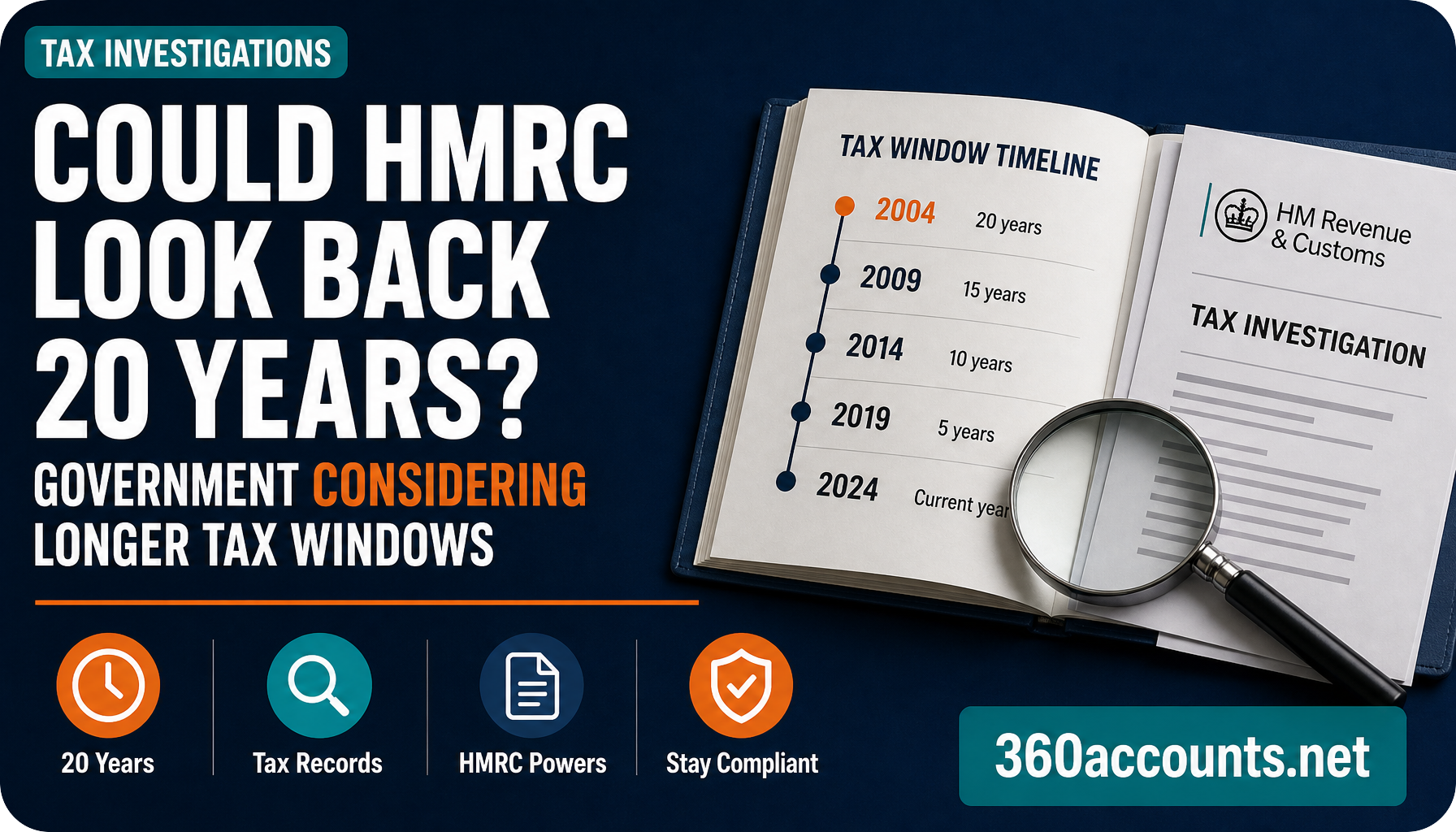
HMRC's ability to reach back through years of tax history is quietly expanding. Alongside long-standing 20-year rules for deliberate under-declaration, new tax adviser powers are heading into law and the direction of travel is unmistakable: HMRC wants more time, more information, and more reach into historic tax affairs. All figures and rates in this guide are correct as of 10 August 2026.
- HMRC already has a 20-year assessment window for "deliberate" errors — far longer than the standard 4-year limit.
- New Finance Bill measures give HMRC stronger powers over tax advisers, including a 20-year look-back on adviser conduct.
- Mandatory tax adviser registration from April 2026 means HMRC can trace who prepared your returns more easily than ever.
- Good record-keeping and honest disclosure remain your strongest protection, whatever the eventual scope of these powers.
- Businesses with any history of estimates, cash transactions, or offshore income face the highest exposure.
What's actually changing
Under current rules, HMRC can amend a tax return within 4 years of the end of the tax year for ordinary errors, 6 years where behaviour is judged "careless", and up to 20 years where behaviour is found to be "deliberate" — for example, deliberately hiding income or filing an inaccurate return on purpose. These time limits are not new, but recent government activity signals they are becoming a bigger part of HMRC's compliance strategy rather than a rarely-used backstop.
Draft legislation moving through the Finance Bill also extends HMRC's reach over tax advisers who facilitate non-compliance, including a 20-year look-back on adviser conduct in the most serious cases. Professional bodies such as the CIOT have already raised concerns that few advisers or firms retain records for two decades, which itself creates a compliance headache even for those who have done nothing wrong.
Who this affects
The heaviest exposure falls on anyone with a history of estimated figures, undeclared cash income, offshore assets, or informal record-keeping. That includes:
- Sole traders and freelancers who have historically kept looser paper records
- Small business owners with cash-heavy trades (hospitality, trades, retail)
- Ltd company directors with historic loan account or dividend irregularities
- Anyone who has used a tax adviser later found to have facilitated non-compliance
If your affairs have always been filed accurately and on time through personal tax returns prepared with proper evidence, the standard 4-year window still applies to you in the vast majority of cases.
What businesses and individuals should do now
- Locate and digitise historic records — invoices, bank statements, mileage logs — for at least the last 6 years, and ideally longer if your trade is cash-based.
- Review any past estimates or "best guess" figures submitted to HMRC and correct them proactively where possible.
- Check who has prepared your returns historically and confirm they are registered ahead of the April 2026 adviser registration deadline.
- Consider HMRC investigation insurance to cover professional fees if an enquiry does open.
- If you run a limited company or operate as a sole trader, book an annual health-check with your accountant rather than waiting for a letter from HMRC.
The 20-year assessment window for deliberate behaviour already exists today. What's new is draft legislation extending 20-year look-back powers specifically to tax adviser conduct, moving through the Finance Bill process. Learn more via our HMRC investigations support page.
The extended time limits are reserved for cases judged "deliberate", not honest mistakes. Careless errors are capped at 6 years, and genuine mistakes at 4. However, HMRC's definition of "deliberate" can be broader than taxpayers expect, so it pays to review historic returns with a professional. See our personal tax return service.
Yes, cash-based sole traders are among the highest-risk groups, simply because gaps in evidence can be misread as deliberate concealment even when they aren't. Tightening up your sole trader accounts now is the best protection.
Review historic director's loan accounts, dividend paperwork, and any benefit-in-kind reporting for the last 6–10 years. Our limited company accounts team can run a compliance review alongside your usual filings.
Yes — HMRC investigation insurance covers professional representation fees if HMRC opens an enquiry, regardless of how far back it reaches.
Come forward voluntarily. HMRC's disclosure facilities generally result in lower penalties than if they discover the error themselves. Speak to us via our contact page before deciding how to proceed.
Worried about historic tax exposure or an upcoming HMRC change? Talk to our team today.
Get in Touch