
HMRC's AI Recovered £10 Billion, Small Business Accounts for 62% of the Tax Gap
HMRC's AI Recovered £10 Billion, Small Business Accounts for 62% of the Tax Gap
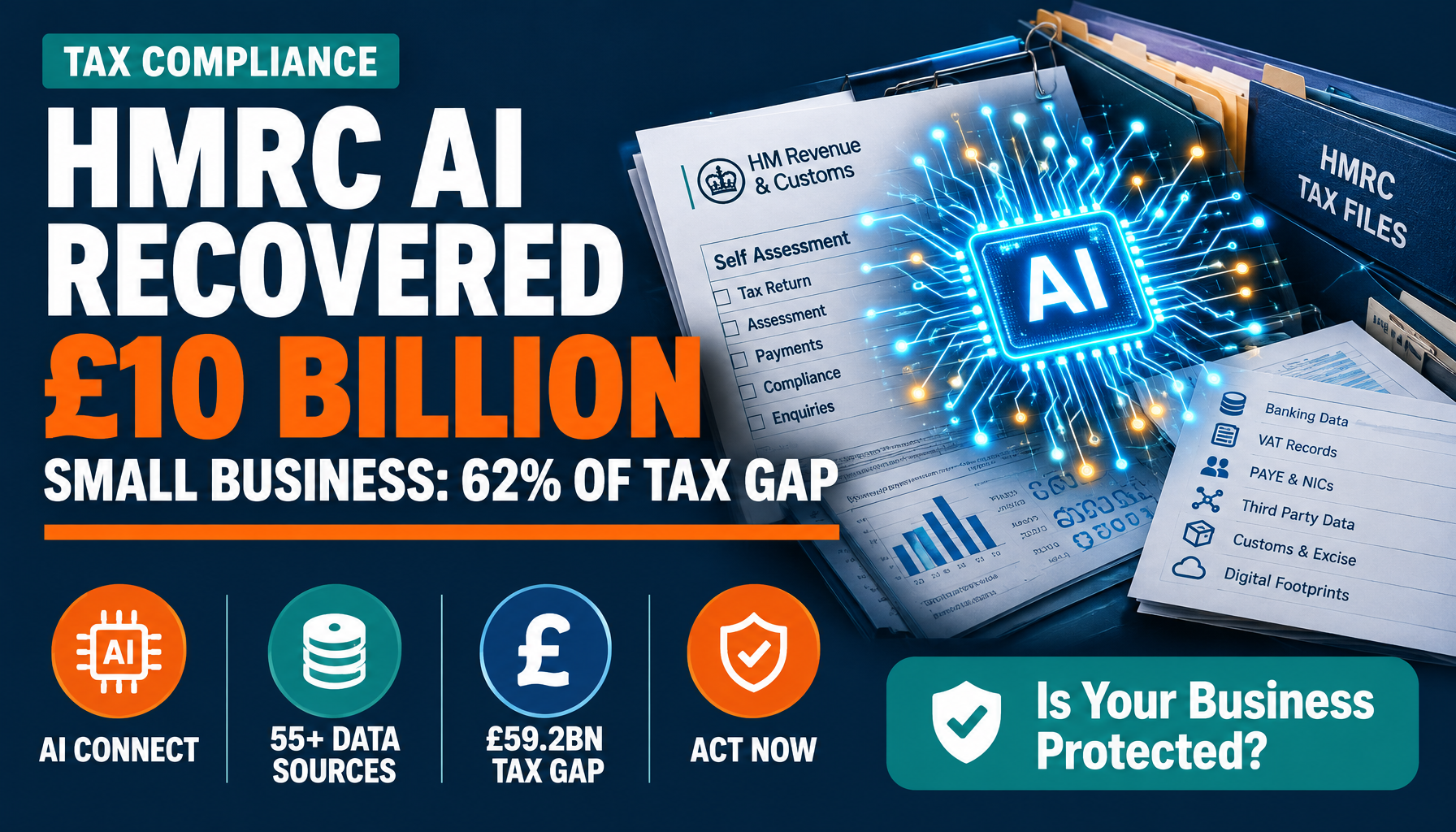
As of 18 September 2026, HMRC's own figures confirm what many advisers have suspected for some time: artificial intelligence and data-matching technology are now doing much of the heavy lifting in HMRC's compliance work, and small businesses are firmly in the spotlight. HMRC reports that AI-supported activity has helped recover approximately £10 billion in additional compliance yield, while its latest tax gap statistics show small businesses account for 62% of the £59.2 billion UK tax gap for 2024/25, up from 58% just four years earlier. If you run a small business, work as a sole trader, or direct a limited company, this is a shift worth understanding, not fearing.
Key Takeaways
- The UK tax gap was £59.2 billion in 2024/25, equal to 6.4% of tax theoretically due, up from 5.3% the previous year.
- Small businesses account for 62% of that gap, roughly £36.7 billion, and their share has risen from 58% in 2020/21.
- HMRC says AI and data-matching activity contributed to around £10 billion in additional compliance yield, with a return of £34.70 for every £1 spent on investigations.
- Small business compliance yield is reported up 22%, and HMRC's Connect system now cross-references more than 55 data sources, from bank data to Companies House filings.
- 81,000 "nudge" letters have gone to cryptoasset holders in the past year alone, almost 25% more than the year before — a clear sign of where automated data-matching is heading next.
The scale of the tax gap in 2024/25
HMRC's official statistics put the total UK tax gap at £59.2 billion for 2024/25, representing 6.4% of the tax that should theoretically have been collected. That is a rise from 5.3% the year before, and it is the largest single-year percentage the tax gap has reached in some time. Within that total, small businesses are by far the largest contributor, responsible for 62% of the gap, up from 58% in 2020/21. Individuals, by contrast, make up only around 4% of the total gap. The direction of travel is clear: HMRC's compliance strategy is increasingly focused on the small business population, not on individual taxpayers or large corporates.
How HMRC's AI and data-matching actually work
HMRC's Connect system is the engine behind much of this activity. It cross-references more than 55 data sources, including bank and card payment information, Land Registry records, Companies House filings, PAYE and VAT returns, and even social media activity. The system does not simply flag a single suspicious transaction; it builds a picture of a business or individual's financial life and compares that picture against what has actually been declared. Where the two do not line up, HMRC can open a compliance check or send a targeted letter asking for an explanation.
A data mismatch is a question, not a verdict
It is important to be clear: a flag from Connect does not mean HMRC has found wrongdoing. It means the figures do not currently match, and HMRC wants an explanation. Genuine timing differences, multiple income streams, or simple recording errors can all trigger a query. The risk lies in not having records that clearly show why the numbers are what they are.
Crypto is the clearest example of AI-driven targeting
Nowhere is this shift more visible than in HMRC's crypto crackdown. Figures obtained through a Freedom of Information request show HMRC sent around 81,000 warning letters to cryptoasset holders in the 12 months to April 2026, up from roughly 65,000 the year before, a rise of about 25%. The letters target people HMRC believes may have underpaid Capital Gains Tax or Income Tax on disposals made during the 2022 to 2025 crypto price swings, including token-to-token swaps that many investors do not realise are taxable events. From 2027, new international reporting rules covering dozens of jurisdictions will feed even more data into this system, meaning the volume of these letters is only expected to grow.
Do not ignore an HMRC nudge letter
If you, or your business, receive one of these letters, do not assume it can be filed away or ignored because you believe your affairs are in order. HMRC expects a response, and failing to reply can escalate a routine nudge into a formal enquiry. Gather your records, calculate the position properly, and take advice before you write back.
Why small businesses carry the largest share
Small businesses are not necessarily less honest than other taxpayers, but several structural factors push their share of the tax gap higher. Many small businesses handle cash, operate across several income streams, or rely on manual or part-completed bookkeeping, all of which increase the chance of an innocent error or a delay in recognising income. HMRC's own analysis attributes a significant portion of the small business gap to error and failure to take reasonable care, rather than deliberate evasion. Compliance yield from this segment is reported up 22%, and HMRC has been explicit that Making Tax Digital, real-time PAYE reporting and improved data sharing with banks and platforms are all part of a deliberate strategy to close this particular gap.
What this means for the return on HMRC's investment
HMRC states that for every £1 it spends on tax investigations, it recovers £34.70 in additional revenue. That return on investment is precisely why AI and automated data-matching are receiving continued investment rather than being scaled back. As the technology becomes more capable of comparing declared figures against real-world financial data in near real time, the practical effect for small businesses is that inconsistencies are more likely to be picked up, and picked up sooner, than in the past.
What to do now
- Bring your bookkeeping up to date and reconcile every bank account, card terminal, cash till and payment platform to your accounting records.
- Use MTD-compliant software so that your figures are recorded consistently and are easy to explain if HMRC asks a question.
- Review your expense claims and keep evidence, including mileage logs, receipts and the business purpose behind any material claim.
- Investigate unusual movements in income or margins yourself, before HMRC's system does it for you.
- Respond promptly to any HMRC letter, and bring in an accountant early if you are unsure how to answer it.
Frequently asked questions
What exactly is the "tax gap"?
The tax gap is the difference between the amount of tax that should theoretically be paid under UK law and the amount HMRC actually collects. For 2024/25, HMRC's stated tax gap was £59.2 billion, equal to 6.4% of total tax theoretically due.
Does the 62% figure mean most small businesses are cheating?
No. This is a population-level estimate covering the whole UK small business sector, not an accusation against any individual business. HMRC's own analysis attributes much of this share to error and failure to take reasonable care rather than deliberate evasion, though it still represents a significant compliance priority.
What has HMRC's AI actually recovered?
HMRC reports around £10 billion in additional compliance yield linked to AI-supported activity. "Yield" covers additional tax collected or liabilities established through compliance work, rather than a single automated charge applied to every taxpayer.
What is HMRC's Connect system?
Connect is HMRC's data-matching system. It cross-references more than 55 data sources, including banks, card payment providers, the Land Registry, Companies House and social media, to spot mismatches between declared income and real-world financial activity.
Why is HMRC targeting cryptoasset holders so heavily?
Crypto transactions were historically difficult for HMRC to trace, but improved data sharing with UK-based exchanges, and international rules due from 2027, have changed that. Around 81,000 nudge letters were sent in the past year alone, and each disposal, including swapping one cryptocurrency for another, can be a taxable event even if no cash was withdrawn.
What should I do if I receive a compliance letter from HMRC?
Do not ignore it. Gather the records requested, respond accurately, and speak to an accountant before you reply if you are unsure of your position. Where an error is identified, correcting it promptly and disclosing it fully generally leads to a far better outcome than waiting for HMRC to find it first.
If you would like a second pair of eyes on your bookkeeping before HMRC's systems take a look, our bookkeeping services can help bring your records up to date and keep them audit-ready. Sole traders can find out more about staying compliant through our Making Tax Digital service for the self-employed, while limited company directors may want to review our limited company accounts service. If you have already received a letter or notice from HMRC, our HMRC investigations and compliance support team can help you respond correctly.
Get ahead of HMRC's data-matching
Clean, timely bookkeeping is still the best protection against an HMRC enquiry. We help small businesses, sole traders and Ltd companies across Guildford and Surrey keep their records accurate, reconciled and ready to explain, whatever HMRC's systems throw up.
Book a free callSee our pricing for bookkeeping and accounts support, or contact 360 Accounts & Bookkeeping Ltd to talk through your situation.
Sources checked for this article: GOV.UK, "Measuring tax gaps" statistics (2024/25); HMRC compliance yield and Transformation Roadmap publications; STEP and BBC News reporting on HMRC cryptoasset nudge letters (August 2026); AccountingWEB and Law360 commentary on the 2024/25 tax gap figures. Figures are stated as of 18 September 2026. This article is general information, not personal tax advice.