
HMRC Has Closed Its Free Corporation Tax Filing Service — What Ltd Companies Must Do Now
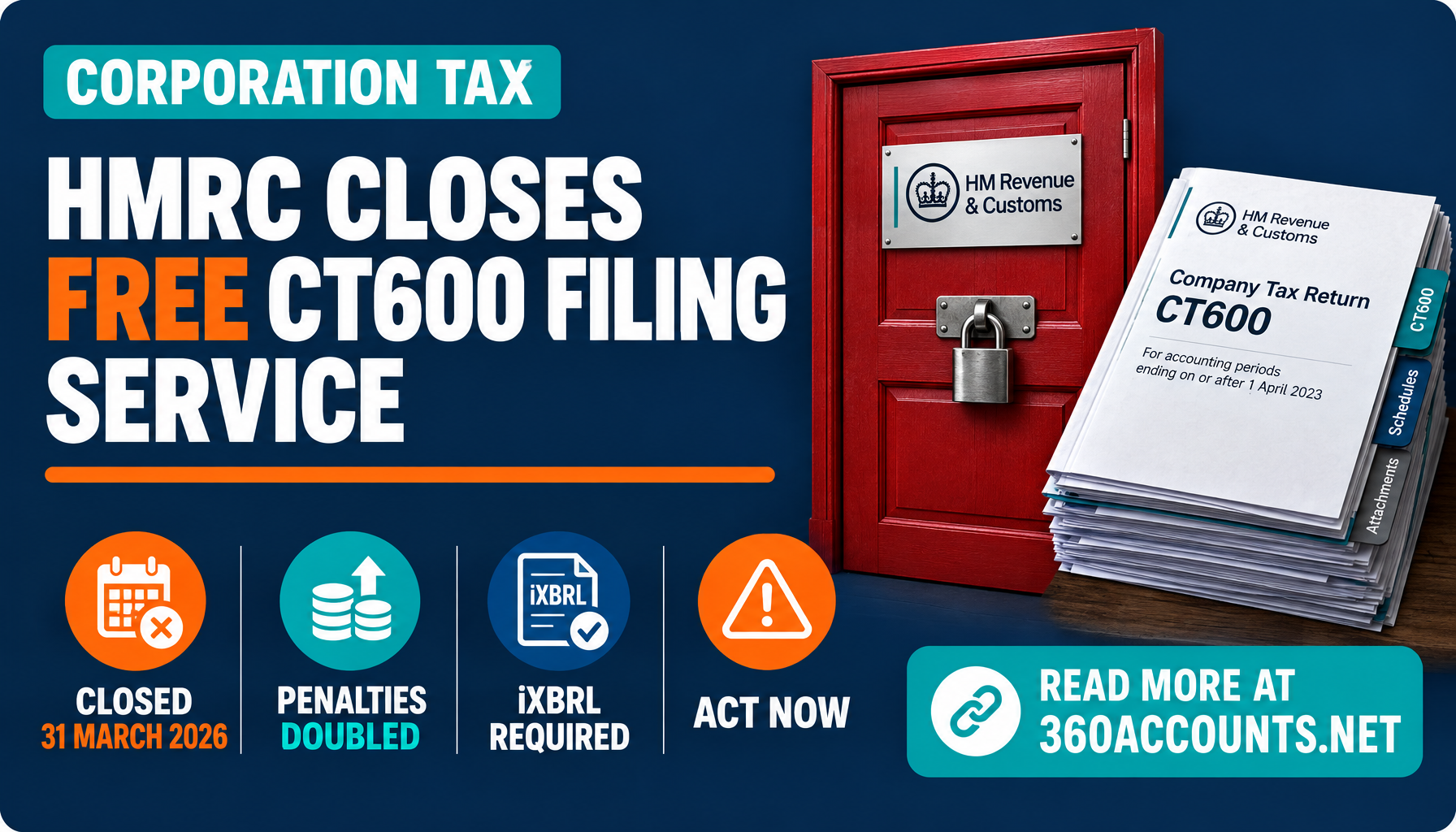
As of 18 September 2026, HMRC has permanently closed its free online service for filing company accounts and Corporation Tax returns. The joint "File your accounts and Company Tax Return" service — used by thousands of small and micro limited companies to submit their CT600 directly to HMRC at no cost — shut down on 31 March 2026. If your company has not yet made other arrangements, this is one of the most important compliance changes you need to act on now.
Key Takeaways
- HMRC's free CT600 filing service closed permanently on 31 March 2026 — there is no free HMRC replacement.
- From 1 April 2026, all limited companies must use HMRC-recognised commercial software to file their CT600, Corporation Tax computation and statutory accounts.
- Late filing penalties doubled from 1 April 2026 — a return one day late now costs £200, up from £100.
- The filing deadlines have not changed: 12 months after your accounting period ends to file the CT600, but only 9 months and 1 day to pay any Corporation Tax owed.
- Popular options include FreeAgent, Xero, QuickBooks, Sage and specialist packages such as IRIS and TaxCalc — or you can leave the whole job to an accountant.
What has actually changed
For years, HMRC provided a joint online service allowing eligible companies to file both their statutory accounts (via a link to Companies House) and their Company Tax Return (CT600) for free, directly through the government's own portal. This was particularly popular with small owner-managed limited companies filing their own returns without an accountant.
HMRC first announced the closure back in March 2025, and the service went offline for good on 31 March 2026. As of 18 September 2026, there is no free HMRC alternative. Every company now needs HMRC-recognised commercial software to prepare and submit a CT600, the accompanying Corporation Tax computation, and the accounts themselves in the correct iXBRL (Inline eXtensible Business Reporting Language) format.
Why iXBRL matters
HMRC requires Company Tax Returns and accounts to be tagged in iXBRL format so its systems can read the financial data automatically. Without recognised software, you cannot produce a valid iXBRL submission — a plain Word document or spreadsheet will be rejected. This is the main reason "just do it yourself for free" is no longer realistically possible for most directors.
The only exceptions: paper filing
HMRC still allows a paper CT600 in narrow circumstances — if you have a genuine reasonable excuse for not filing online, or if you are filing in Welsh. For the vast majority of companies, online filing through commercial software is now mandatory, and Companies House accounts must also be filed using software or by post.
Late filing penalties have doubled
Alongside the closure of the free service, HMRC has doubled its fixed late filing penalties for Company Tax Returns, effective for any return with a filing date on or after 1 April 2026. These penalties had not changed since 1998, and HMRC says the increase simply restores their original real-terms value after nearly three decades of inflation.
| Situation | Old penalty (before 1 April 2026) | New penalty (from 1 April 2026) |
|---|---|---|
| Return filed late | £100 | £200 |
| Return more than 3 months late | £200 | £400 |
| Three successive late filings (initial penalty) | £500 | £1,000 |
| Three successive late filings, more than 3 months late | £1,000 | £2,000 |
Remember: penalties are separate from interest
These fixed penalties apply on top of any interest HMRC charges on Corporation Tax paid late. And if your return is more than 6 or 12 months late, HMRC can also add tax-geared penalties of 10–20% of the unpaid tax, regardless of the fixed penalty above.
Deadlines have not changed — only the route has
It is worth stressing that HMRC has not moved the actual filing or payment deadlines. Directors must still:
- File the CT600 within 12 months of the end of the company's accounting period.
- Pay any Corporation Tax due within 9 months and 1 day of the end of the accounting period — three months earlier than the filing deadline itself.
This gap between the payment deadline and the filing deadline catches many directors out every year, and it becomes even more costly now that the filing penalty has doubled and there is no free route to submit on time.
What Ltd companies must do now
Action steps
- Check your current filing method. If you or your previous accountant used the free HMRC service, you need a new solution in place before your next Corporation Tax Return is due.
- Choose HMRC-recognised software. Popular options for small companies include FreeAgent, Xero, QuickBooks, Sage, and specialist Corporation Tax packages such as IRIS and TaxCalc. Check that any package you choose can produce a CT600, the tax computation and iXBRL-tagged accounts, not just one of the three.
- Diarise both deadlines separately. Set a reminder for the 9-month payment deadline and a separate one for the 12-month filing deadline — do not assume they are the same date.
- Get set up well before your deadline. Software setup, data migration and getting comfortable with a new system all take time. Do not leave this until the month your return is due.
- Consider using an accountant. If you were previously self-filing to avoid software costs, it is now worth comparing that cost against having a qualified accountant handle your Corporation Tax Return, accounts and Companies House filing together.
Which software should you choose?
There is no single "best" option — it depends on your company's size, whether you already use cloud accounting software, and how much of the process you want to handle yourself.
- FreeAgent — popular with small companies and sole traders, and free for many NatWest, RBS and Mettle business banking customers.
- Xero and QuickBooks — widely used cloud accounting software, often used alongside a bolt-on or accountant-managed Corporation Tax module.
- Sage — a long-standing choice for small and growing businesses, with Corporation Tax filing capability built into some packages.
- IRIS and TaxCalc — professional-grade software typically used by accountants and bookkeepers on behalf of client companies.
Many directors are finding that, rather than paying for and learning a new software package themselves, it is simpler and often cheaper overall to let their accountant handle the whole Corporation Tax filing process using professional software they already hold.
Frequently asked questions
Is there still a free way to file a CT600 with HMRC?
No. As of 1 April 2026, HMRC no longer offers a free online filing route for the CT600, the Corporation Tax computation, or company accounts. The only remaining free-of-charge routes are the very limited paper filing exceptions for companies with a reasonable excuse or those filing in Welsh. Everyone else must use commercial software, most of which involves a fee, either per return or via a subscription.
What happens if I miss the deadline because I did not have software in place?
HMRC does not treat "I did not have software" as an automatic reasonable excuse for late filing. If your CT600 is filed after the 12-month deadline, the new doubled penalties apply from £200 upward, and interest will accrue separately on any Corporation Tax paid after the 9-month payment deadline. It is important to arrange software or an accountant well ahead of your filing date rather than waiting until the deadline is close.
Do the Corporation Tax payment and filing deadlines fall on the same date?
No, and this is a common source of confusion. Corporation Tax payment is due 9 months and 1 day after your accounting period ends, while the CT600 filing deadline is a full 12 months after the same period end. Many companies pay on time but then file late, or vice versa, so it is worth tracking both dates separately in your calendar.
Can I still use a spreadsheet or Word document to prepare my return?
No. HMRC requires the Company Tax Return and accounts to be submitted in iXBRL format, a structured tagging language that allows HMRC's systems to read the financial data automatically. A plain spreadsheet or Word document cannot produce a valid iXBRL file, so HMRC-recognised commercial software or professional support is now essential for every submission.
My company is dormant — do I still need to do all this?
Dormant companies may be able to apply for a Corporation Tax filing exemption if they are a charity, community amateur sports club, or flat management company. However, even dormant companies must still file annual accounts with Companies House every year, so this closure does not remove all of your filing obligations.
What is the cheapest way to comply with the new rules?
For very simple, single-director companies, budget commercial software packages exist specifically to produce a CT600 and iXBRL accounts at low one-off cost. However, once you factor in the time needed to learn a new system, check your own figures, and correct any submission errors, many directors find that using a bookkeeper or accountant works out similarly priced and considerably less stressful, particularly given the doubled penalties for getting it wrong.
Don't leave this until your deadline is close
With no free HMRC route left and penalties now double what they were, the cost of leaving your Corporation Tax filing to the last minute has never been higher. If your next accounting period end is approaching, now is the time to put a software solution or an accountant in place.
Let us handle your Corporation Tax filing
We prepare and file CT600 returns, Corporation Tax computations and statutory accounts for limited companies across Guildford and Surrey using fully HMRC-recognised software — so you never have to worry about penalties, iXBRL formatting or missed deadlines.
Book a free callSee our pricing for limited company accounts and Corporation Tax filing, or find out more about our bookkeeping services to keep your records ready ahead of every deadline.