
HMRC Can Raid Your Bank Account: What Every Business Owner Needs to Know About Direct Recovery of Debts
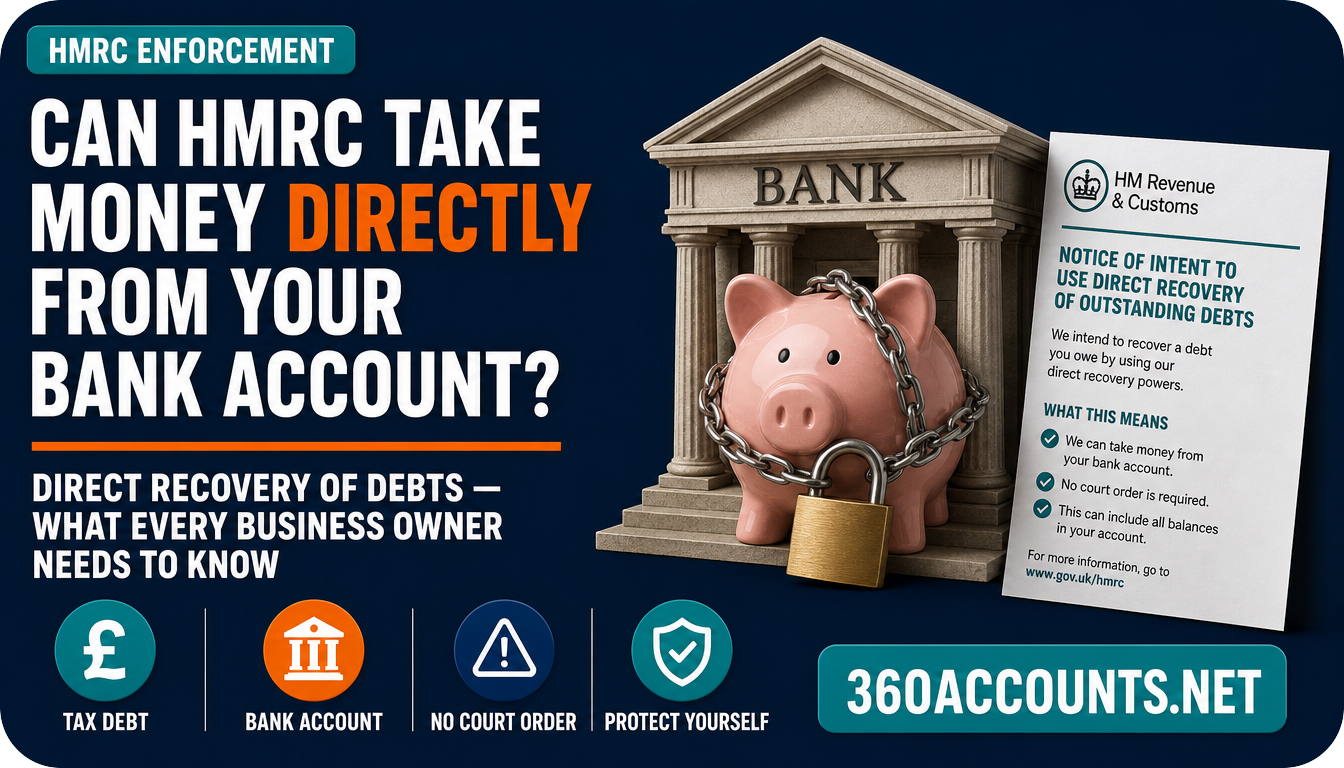
HMRC Can Raid Your Bank Account — What Every Business Owner Needs to Know About Direct Recovery of Debts
Most people assume that if HMRC wants to take money from them, it has to go to court first. That assumption is wrong. Under powers known as Direct Recovery of Debts (DRD), HMRC can contact your bank directly and instruct it to freeze and transfer funds from your account to cover unpaid tax — without a court order. These powers, introduced in 2015 but now actively being used again following a 2025 restart, represent one of the most significant enforcement tools in HMRC’s arsenal.
✅ Key Takeaways
- HMRC can take money directly from your bank or building society without a court order.
- DRD applies to debts of £1,000 or more across PAYE, Self Assessment, VAT, and Corporation Tax.
- HMRC must always leave a minimum of £5,000 across all your accounts.
- You will receive a warning letter first — but the window to respond is short.
- ISAs and joint accounts can be targeted if HMRC believes funds are held there.
- Engaging quickly with HMRC is your strongest protection.
What Is Direct Recovery of Debts?
DRD gives HMRC the legal authority to instruct a bank or building society to deduct money directly from a debtor’s account to settle an outstanding tax liability. It applies where a taxpayer owes at least £1,000 and has been contacted multiple times without resolving the debt.
Crucially, HMRC does not need to obtain a court judgment to use DRD. It can act unilaterally, subject to a set of procedural safeguards designed to give the taxpayer a chance to respond.
DRD was legislated under the Finance (No.2) Act 2015. It was initially piloted cautiously and then largely paused. HMRC restarted active use of DRD from late 2025 as part of a broader push to close the UK’s tax gap, which currently stands at around £39.8 billion per year.
Who Can Be Targeted?
Any individual or business that owes confirmed, undisputed tax debt to HMRC may be subject to DRD, including:
- Sole traders with overdue Self Assessment tax bills
- Limited company directors with unpaid Corporation Tax or PAYE liabilities
- VAT-registered businesses with outstanding VAT returns
- Any taxpayer who has ignored repeated HMRC correspondence
How Does the Process Work?
HMRC follows a structured process before using DRD:
- Step 1 — Multiple contact attempts: HMRC will have already written, called, or emailed you about the debt on several occasions.
- Step 2 — Final warning letter (Hold Notice): You will receive a formal notice giving you 30 days to contact HMRC and make arrangements to pay.
- Step 3 — Account inspection: HMRC contacts your bank to verify you have sufficient funds.
- Step 4 — Freezing and transfer: If you have not responded, HMRC instructs the bank to hold the funds and transfer them after a further 14 days.
Once a Hold Notice is issued, you have just 30 days to contact HMRC and make a payment arrangement. After that, the funds can be frozen. Do not ignore HMRC letters — every day of delay narrows your options.
What Safeguards Exist?
While DRD is a powerful tool, there are important protections built in:
- HMRC must always leave £5,000 across all your accounts after recovery — it cannot leave you with nothing.
- DRD cannot be used if the debt is disputed — if you believe the amount is wrong, you have the right to challenge it.
- You have the right to request an independent review by HMRC’s Solicitors Office or apply to a County Court to challenge the action.
- HMRC must give you a face-to-face visit before proceeding if you request one.
Can ISAs and Joint Accounts Be Targeted?
Yes — this surprises many people. HMRC can target Cash ISAs and joint accounts if it believes the taxpayer holds funds there. For joint accounts, HMRC can only take the debtor’s share of the funds, but the practical effect is that both account holders will be notified and the account will be disrupted.
What Should You Do If You Receive a DRD Notice?
- Act immediately — do not wait until the 30-day deadline has nearly passed.
- Call HMRC’s Business Payment Support Service on 0300 200 3835 to discuss a Time to Pay arrangement.
- Check the debt is correct — if you believe the figure is wrong, raise a formal dispute before the funds are frozen.
- Seek professional advice — a qualified accountant or tax adviser can negotiate with HMRC on your behalf and help you avoid enforcement action.
- Do not move money around to avoid DRD — HMRC may treat this as deliberate evasion, which can trigger criminal investigation.
How to Avoid DRD in the First Place
The best protection is staying on top of your tax obligations year-round:
- File all returns on time — Self Assessment, VAT, PAYE, and Corporation Tax.
- Pay all tax liabilities by their due dates — set calendar reminders well in advance.
- If you cannot pay in full, contact HMRC proactively to agree a Time to Pay plan before the deadline passes.
- Keep your contact details up to date with HMRC so warning letters reach you.
- Work with an accountant who monitors your tax position and flags issues early.
The Bottom Line
Direct Recovery of Debts is a real and growing enforcement risk for any business or sole trader with unresolved tax liabilities. The key message is simple: do not ignore HMRC correspondence. If you are struggling with a tax debt, engaging early — ideally before HMRC sends a DRD notice — gives you the best chance of agreeing a manageable repayment plan and avoiding your bank account being frozen.
If you have received an HMRC letter about an unpaid tax liability and are unsure what to do next, 360 Accounts can help. We work with sole traders and limited companies across Surrey and beyond to resolve HMRC issues quickly and professionally.