HMRC Late Payment Interest Rises to 8%: What Unpaid Tax Now Costs You
 Written by Gary Winterborne - AATQB, AATQB · Partner
HMRC Late Payment Interest Rises to 8%: What Unpaid Tax Now Costs You
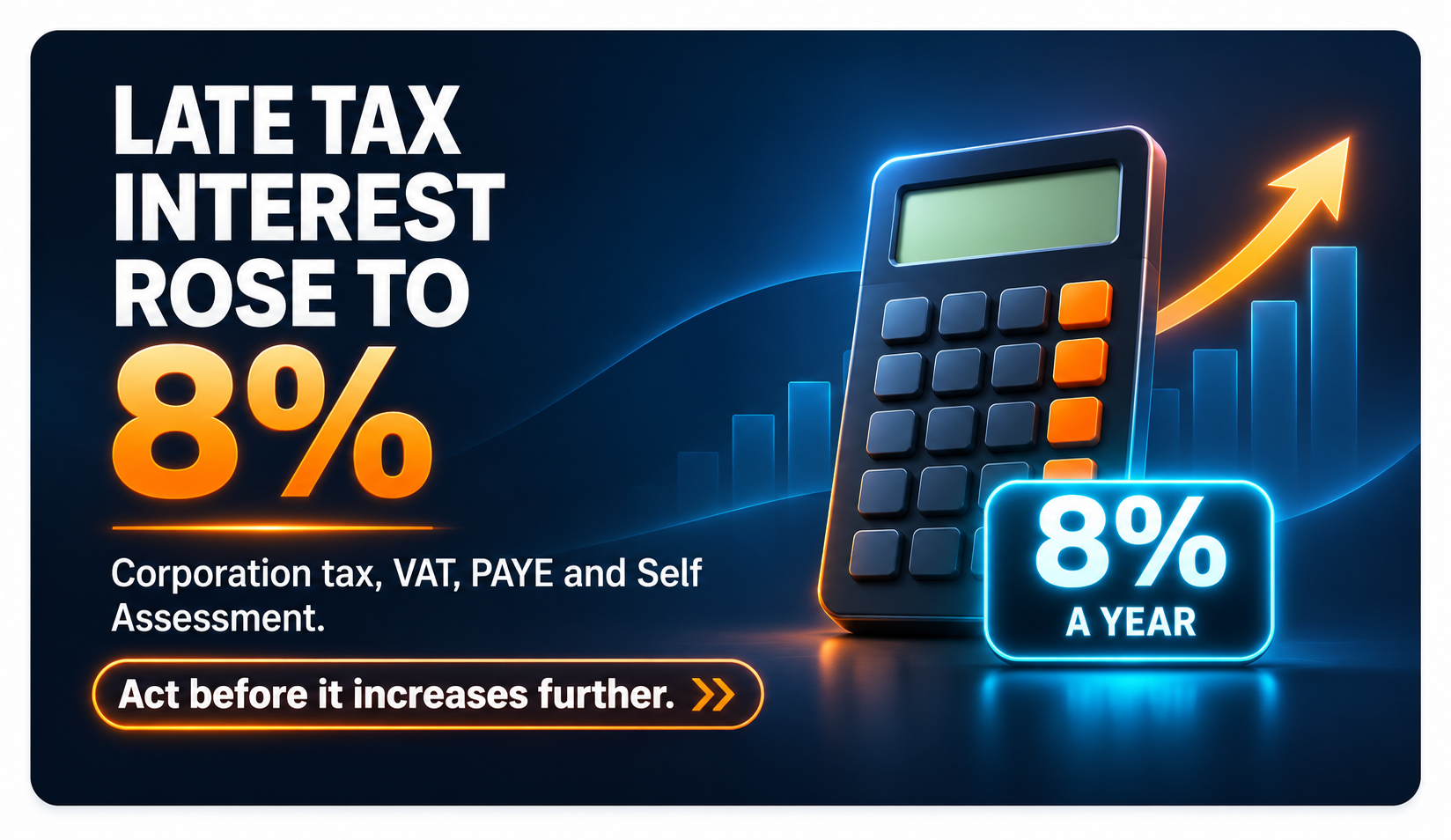
If you owe HMRC money, the bill has just got bigger. From 24 November 2026, HMRC's late payment interest rate rose to 8% a year, following the Bank of England's decision to raise base rate to 4%. Here's what that means in pounds and pence, which taxes it affects, and what to do if you can't pay on time.
Key Takeaways
- HMRC charges late payment interest at Bank of England base rate plus 4 percentage points.
- With base rate at 4%, that means 8% a year on overdue tax (as of 8th December 2026).
- Interest is charged daily, from the day the tax was due until the day it's paid.
- It applies to corporation tax, VAT, PAYE and Self Assessment.
- Can't pay? A Time to Pay arrangement won't stop interest, but agreeing one in time can help stop some penalties.
What's changed, and why?
HMRC doesn't pick its interest rate out of thin air. Late payment interest is linked to the Bank of England base rate, with a fixed margin on top. That margin is 4 percentage points.
It used to be lower. The government raised the margin from 2.5% to 4% with effect from 6 April 2025, as announced at the Autumn Budget 2024. So the cost of paying late had already gone up before this latest change.
Now that base rate has risen to 4%, the sums are simple: 4% plus 4% gives you 8% a year.
The rate right now
As of 8th December 2026, HMRC late payment interest is 8% a year, effective from 24 November 2026. If base rate moves again, HMRC's rate will follow, so always check the current figure on GOV.UK.
What does 8% actually cost you?
Percentages can feel abstract, so let's put some real numbers on it. HMRC uses simple interest, worked out day by day. It isn't compounded, but it starts from the original due date, not from when you get a reminder.
Say you owe £10,000 and pay it a year late. At 8%, that's around £800 in interest on top of the tax. That works out at roughly £2.19 a day, every day, including weekends.
Pay three months late and you're looking at around £200. Not catastrophic on its own, but it's money that buys you nothing, and penalties can be added on top.
It's also worth knowing the rules aren't symmetrical. If you overpay, HMRC's repayment interest is base rate minus 1%, with a minimum of 0.5%. As of 8th December 2026, that's 3%. So HMRC charges you more than twice what it pays you back.
Which taxes does it hit?
The short answer is almost every tax a small business pays. Here's how it plays out for each one.
Corporation tax. If your limited company pays its corporation tax late, interest runs from the due date. Larger companies paying by quarterly instalments are treated differently and have their own, lower interest rate, but most small companies will be on the standard late payment rate.
VAT. For VAT return periods starting on or after 1 January 2023, late payment interest sits within the points-based penalty and interest regime. That means interest on what's overdue, plus separate late payment penalties. Paying late can cost you twice.
PAYE. The tax and National Insurance you deduct from staff wages has to reach HMRC on time too. Late PAYE payments attract interest in the same way.
Self Assessment. If you're a sole trader, landlord or director with a personal tax bill, interest runs on anything unpaid after the balancing payment deadline of 31 January and the second payment on account deadline of 31 July. Getting your personal tax return done early helps you know what's coming and plan for it. If you're self-employed, keeping your sole trader accounts up to date throughout the year makes those bills far less of a surprise.
Next big deadline
The next Self Assessment balancing payment deadline is 31 January 2027. Any amount still unpaid after that date will start building interest at the current rate.
Can't pay? Talk to HMRC early
Cash flow doesn't always cooperate with tax deadlines. If you know you can't pay in full, the worst thing you can do is ignore it. The best thing is to contact HMRC before the deadline and ask about a Time to Pay arrangement.
A Time to Pay arrangement is simply an agreed instalment plan. You spread the bill over a period you can realistically afford. Interest still runs on the outstanding balance, so it isn't free money. But agreeing a plan in time can stop some late payment penalties from being charged, for example under the VAT penalty regime.
HMRC will want to see that your plan is realistic. A little preparation goes a long way.
Before you call HMRC
- Your reference number (UTR, VAT number or PAYE reference)
- The amount you owe and which tax it relates to
- What you can pay upfront today
- A realistic monthly amount you can afford
- A rough picture of your income and outgoings
- Your bank details for setting up payments
Simple ways to stay ahead
The cheapest interest is the interest you never pay. A few habits make a big difference.
Set money aside as you go. Moving a percentage of each invoice or payment into a separate savings account means the tax is there when it's due.
Know your deadlines. Put every payment date in your calendar with a reminder a few weeks before.
Don't wait for HMRC to chase you. Interest starts on the due date, not when the letter arrives.
Get your figures early. The sooner you know what you owe, the more time you have to plan or ask for help. If something isn't adding up, talk to us before the deadline rather than after.
Your Questions Answered
What is HMRC's late payment interest rate now?
As of 8th December 2026, it's 8% a year, which is Bank of England base rate of 4% plus HMRC's 4 percentage point margin.
When does interest start?
From the day the tax was due, and it's charged daily until the day you pay.
Is HMRC interest compounded?
No, it's simple interest, worked out daily on the amount you owe.
Does a Time to Pay arrangement stop interest?
No, interest keeps running on the outstanding balance, but agreeing a plan in time can help you avoid some penalties.
Is late payment interest the same as a penalty?
No, they're separate, so you can be charged interest and a late payment penalty on the same overdue tax.
Does HMRC pay interest if I overpay?
Yes, at base rate minus 1% with a minimum of 0.5%, which is 3% as of 8th December 2026.
Not sure where you stand?
If you owe HMRC money or think you might struggle with a coming bill, our Guildford team can help you work out the numbers and your options. Get in touch with 360Accounts.
Follow 360Accounts
Quick tax tips, deadline reminders and plain-English updates for small businesses.
Facebook Instagram LinkedIn YouTubeWEBSITE Q&A SNIPPET — DROP INTO ANY PAGE
How is HMRC late payment interest worked out?
It's set at Bank of England base rate plus 4 percentage points and charged as simple interest, daily, from the date the tax was due until it's paid.
Which taxes attract HMRC late payment interest?
Overdue corporation tax, VAT, PAYE and Self Assessment all attract late payment interest.
Does a Time to Pay arrangement stop HMRC interest?
No, interest continues on the outstanding tax, but agreeing an arrangement in time can stop some late payment penalties.
Is HMRC interest the same as a late payment penalty?
No, interest and penalties are separate charges, so you can be charged both on the same overdue tax.
About the author
Gary Winterborne - AATQB, AATQB · Partner
Meet Gary! From professional cricketer to business owner, Gary has enjoyed a varied career, running businesses across industries including construction and retail. His hands-on experience means he understands the challenges business owners face. Friendly, approachable and passionate about helping others succeed, Gary brings real-world business knowledge to 360 Accounts & Bookkeeping. He believes accounting should be straightforward, stress-free and focused on helping your business grow.