
Is HMRC About to Make the Self-Employed Pay Tax Every Month?
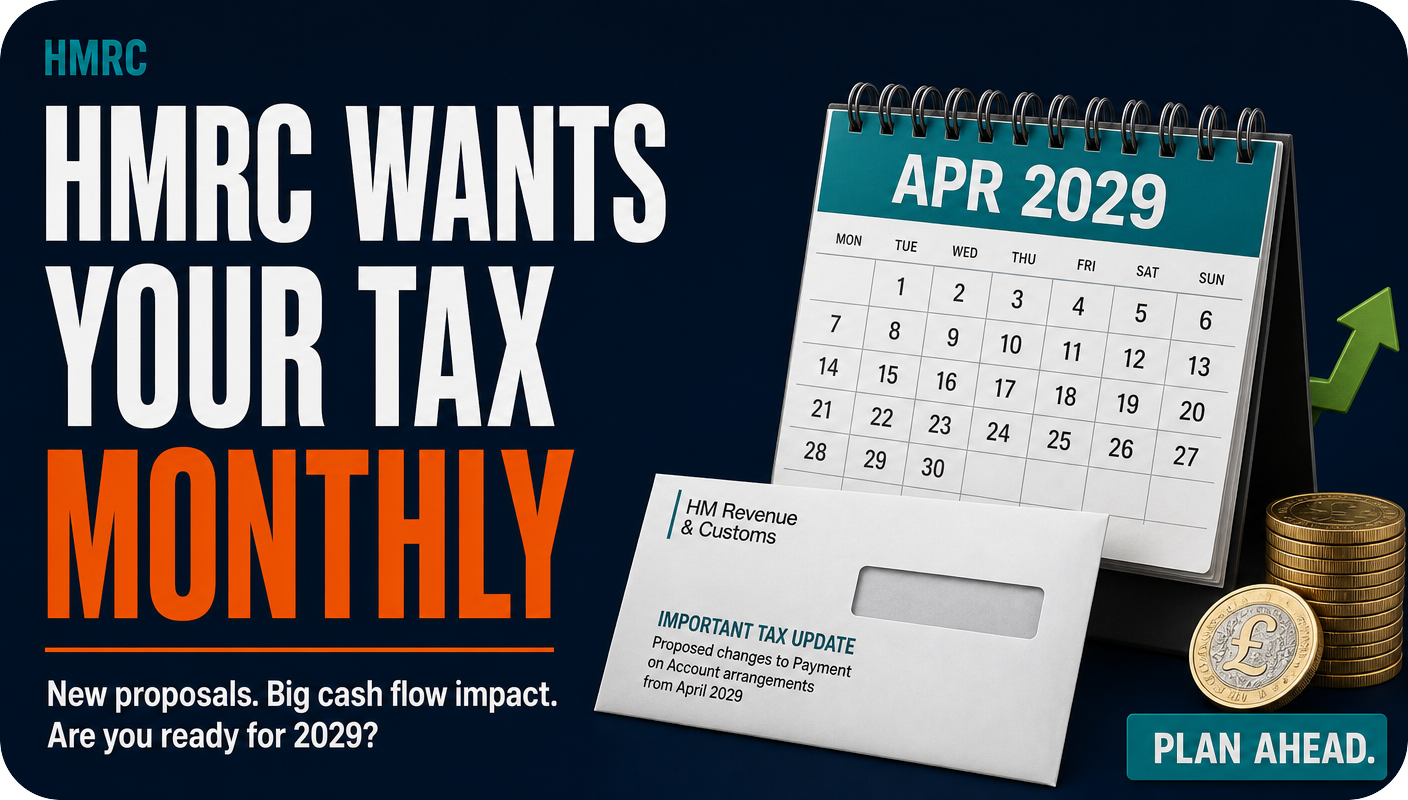
If you are self-employed, a sole trader, or a landlord, there is a significant change on the horizon. HMRC is consulting on plans that could see the self-employed paying tax monthly or quarterly from April 2029. All figures and proposals in this article are correct as of 19 July 2026, based on HMRC's active "Timely Payments" consultation, which runs until 4 August 2026.
- HMRC is consulting on monthly or quarterly tax payments from April 2029.
- Taxpayers with PAYE income may have tax deducted via their tax code each month.
- Sole traders and landlords without PAYE could face monthly or quarterly direct payments.
- Consultation closes 4 August 2026 — government response due Autumn 2026.
- Now is the time to review your cash flow and business structure.
How Tax Payments Work Right Now
- If your bill exceeds £1,000: two advance payments of 50% each.
- 31 January — first payment (50% of previous year's bill).
- 31 July — second payment (another 50%).
- Balancing payment due 31 January following year.
- Does not apply if 80%+ of tax collected via PAYE.
What HMRC Is Proposing
The "Timely Payments" consultation proposes two routes:
Route 1 — PAYE taxpayers: Self Assessment tax collected monthly through your tax code (~8.3% per month), with a January balancing payment.
Route 2 — Pure sole traders/landlords: Monthly or quarterly direct payments. HMRC may also lower the £1,000 trigger threshold.
Respond before that date if you want your voice heard. Government response expected Autumn 2026. Implementation planned April 2029.
Cash Flow Impact
This does not change how much you owe — only when you pay. But monthly payments require a consistent cash buffer. Seasonal businesses and those with irregular income face the biggest challenge. A transition overlap risk exists: 2028/29 liabilities settling under old rules while 2029/30 monthly payments begin simultaneously.
How This Links to Making Tax Digital
MTD for Income Tax (mandatory for sole traders and landlords above £50,000 from April 2026) already requires quarterly submissions. Monthly payments are the logical next step — HMRC uses quarterly data to calculate your instalments. See our Self-Employed MTD service.
- Keep records up to date — our bookkeeping services can help.
- Treat tax as a monthly cost, not a twice-yearly bill.
- File your Self Assessment return early.
- Check your MTD status via our MTD service page.
- Speak to your accountant if your income is seasonal or variable.
Who Is Most Affected?
- Sole traders — variable profits hit hardest. See our sole trader accounts service.
- Freelancers and contractors — irregular income makes fixed monthly payments challenging.
- Landlords — void periods and repairs create income variability.
- Director-shareholders — PAYE salary may trigger tax code collection.
- Anyone with a bill over £1,000 — directly relevant to you.
Is It Time to Become a Limited Company?
Monthly payment pressure is prompting many sole traders to consider incorporating. A limited company pays Corporation Tax — not Income Tax and NI. As of 19 July 2026, the small profits rate is 19% (profits up to £50,000), rising to 25% above £250,000. Directors draw salary plus dividends — dividends carry no NI.
- Sole trader: Income Tax 20%/40%/45% + Class 4 NI 6% (to £50,270) / 2% above. Payments on account if bill > £1,000.
- Ltd company: Corporation Tax 19%–25%. Salary via PAYE + dividends (8.75% basic / 33.75% higher / 39.35% additional — no NI on dividends).
- Cash flow: Corporation Tax due 9 months + 1 day after year-end — later and more predictable than proposed monthly self-employed payments.
- Switch threshold: Generally tax-efficient above £50,000 profit.
- Profits consistently above £50,000? Incorporation could save significant NI and tax.
- Irregular income? A Ltd company lets you retain profits and draw dividends when it suits you.
- Read our guide: Sole Trader to Limited Company — When to Make the Switch.
- Book a free call to model the numbers for your situation.
How 360Accounts Can Help
The direction of travel is clear: HMRC wants more frequent records, reporting, and payments. Businesses with clean books and a clear tax picture year-round will manage the transition far more easily. At 360Accounts, we help sole traders, landlords and small businesses across Surrey stay ahead of these changes — from Self Assessment to MTD compliance and cash flow planning.
Worried about what HMRC's monthly tax plans mean for you?
Book a free call and we will walk you through your options — before the rules change.
Book a Free Call TodayQuestions & Answers
Is HMRC definitely going to make self-employed people pay tax monthly?
Not yet — as of 19 July 2026 this is a consultation. It closes 4 August 2026, response due Autumn 2026, implementation April 2029 if confirmed.
How are payments on account currently calculated?
50% of previous year's Self Assessment bill, due 31 January and 31 July. Applies when bill exceeds £1,000. See our personal tax return service for help.
Who is most affected by the proposals?
Sole traders, freelancers, landlords, and anyone with Self Assessment payments on account. ~2.1 million PAYE taxpayers would have tax collected via their tax code monthly.
Will I pay more tax under the new system?
No — the total bill stays the same. Only when you pay changes. But cash flow impact is real, especially for seasonal businesses.
Could switching to a limited company help?
Possibly. Corporation Tax is due 9 months after year-end — later than proposed monthly self-employed payments. For profits consistently above £50,000, incorporation may reduce tax and ease cash flow. Read: Sole Trader to Ltd — When to Switch, or book a free call.
What should I do right now?
Treat tax as a monthly cost, keep records up to date, file Self Assessment early, and speak to an accountant. Book a free call with 360Accounts to plan ahead.