
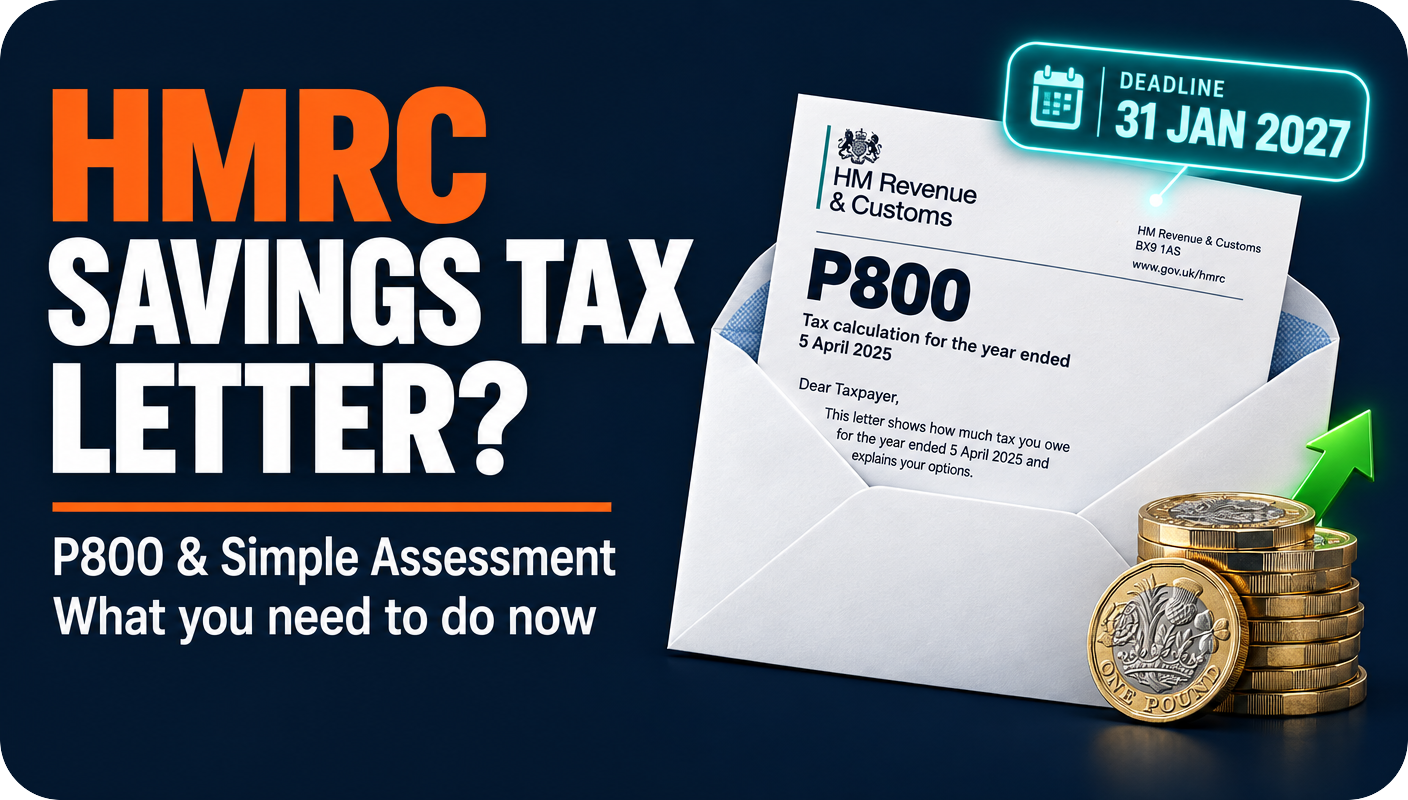
HMRC Is Sending P800 and Simple Assessment Letters for Savings Interest, Are You Affected?
HMRC has started sending letters to people who may owe tax on savings interest, and many recipients will not have been expecting them. As of 22 September 2026, P800 and PA302 Simple Assessment letters are being issued for tax relating to interest earned between April 2025 and April 2026. If you are an employee, pensioner, retiree, sole trader or landlord who has money in ordinary savings accounts, it is worth knowing what these letters mean and what to do next.
Key takeaways
- As of 22 September 2026, the Personal Savings Allowance is £1,000 for basic rate taxpayers, £500 for higher rate taxpayers and £0 for additional rate taxpayers.
- HMRC receives savings interest information automatically from banks and building societies.
- A P800 is a calculation, not an investigation. A PA302 Simple Assessment lets you pay directly without filing a tax return for that assessment.
- Deadlines matter, with 31 January 2027 for a P800 payment and 60 days for a PA302 payment.
- If the figures look wrong, you can challenge them rather than simply paying an incorrect amount.
What is a P800 letter?
A P800 is HMRC's end-of-year tax calculation. HMRC uses information from your PAYE record, including your employment or pension income, together with interest reported by banks and building societies, to work out whether you have paid enough tax.
In plain English, a P800 says, "here is our calculation". It is not an investigation and does not normally mean you need to complete a Self Assessment tax return. If the calculation is correct, you can pay the amount shown by the deadline. If it is not correct, you can contact HMRC and ask for the record to be checked.
What is a Simple Assessment, or PA302?
A Simple Assessment is HMRC's way of collecting certain amounts of income tax directly, without requiring you to file a full tax return. The letter is commonly called a PA302. HMRC may use it where an underpayment is too large to collect conveniently by changing your PAYE tax code, or where you do not have a suitable PAYE income source.
Read the payment instructions carefully. A PA302 normally gives you 60 days from the date of the letter to pay. Unlike a tax code adjustment, the amount will not simply be taken from your salary or pension automatically.
Why are savings interest letters being sent in 2026?
Interest rates rose sharply from 2022 and remained relatively elevated during the 2025/26 tax year. As a result, millions of people earned more interest than they had in previous years, sometimes for the first time. Someone who has never needed to think about tax on savings may now be over their allowance.
Banks and building societies report taxable interest to HMRC automatically. HMRC then compares that information with your other income and the Personal Savings Allowance to calculate any tax that appears to be due.
Who is most at risk of receiving a letter?
- Higher rate taxpayers: the Personal Savings Allowance is only £500 as of 22 September 2026, so a relatively modest savings balance can create a tax bill.
- Pensioners and retirees: savings outside an ISA can generate taxable interest, even when your pension income is your only other income.
- Employees who never file a tax return: PAYE usually deals with salary tax, but it does not always prevent a separate adjustment for savings income.
- Landlords and sole traders: you may already have business or personal savings pots producing interest alongside rental or trading income.
What to do if a letter arrives
- Do not panic. A P800 is a tax calculation, not an investigation.
- Check the figures. Compare the interest shown with bank statements and certificates for the period April 2025 to April 2026. Also check your PAYE income, pension income and tax already paid.
- Pay by the deadline if it is correct. For a P800, the payment deadline is 31 January 2027. For a PA302, payment is normally due within 60 days of the letter date.
- Challenge anything that is wrong. Contact HMRC, or ask your accountant to review the calculation and raise the issue for you.
- Consider the future. If your interest regularly exceeds your allowance, check whether you need to register for Self Assessment or whether another PAYE arrangement is appropriate.
Do you need to file a Self Assessment tax return?
Receiving a P800 or PA302 does not automatically mean that you need to file a Self Assessment return. HMRC may be able to collect the tax through PAYE or Simple Assessment instead. However, if your interest regularly takes you over your Personal Savings Allowance, registering for Self Assessment may give you a clearer and more consistent way to report your income rather than waiting for a letter each year.
This can be particularly relevant for higher rate taxpayers, landlords and sole traders with several sources of income. Our Personal Taxation and Self Assessment service can help you understand which reporting method applies to your circumstances. You can also read about our HMRC investigations and compliance support if you need help dealing with a wider HMRC query.
Questions and answers
1. What is a P800 letter and do I need to do anything?
A P800 is HMRC's calculation of whether you have paid the right amount of tax for the year. Check the income, interest and tax figures. If they are correct, pay by the stated deadline, which for this savings interest campaign is 31 January 2027. If they are wrong, contact HMRC before paying or ask an accountant to review them.
2. What is the difference between a P800 and a Simple Assessment, or PA302?
Both can tell you that tax is due, but the collection method differs. A P800 is an end-of-year calculation, often followed by a refund or payment instruction. A PA302 Simple Assessment is used to collect tax directly where HMRC does not intend to collect it through a tax code. A PA302 normally has a 60-day payment deadline.
3. How does HMRC know about my savings interest?
Banks and building societies report interest information to HMRC automatically. HMRC matches that information with your tax record and other income. This is why you may receive a letter even if you are an employee or pensioner who has never completed a Self Assessment return.
4. What if the amount on the letter looks wrong?
Check every account, the relevant tax year and whether any interest was paid into an ISA. Compare the letter with bank statements and check your tax band. If the bank has reported an incorrect figure, ask the bank to correct its information and contact HMRC. Do not ignore the letter or assume the calculation is automatically right.
5. Could I end up needing to file a Self Assessment return?
Possibly, depending on your wider income and circumstances. A one-off P800 or PA302 does not by itself create a Self Assessment obligation. Regular taxable interest above your allowance, or other income from property or self-employment, may make a return appropriate. Get advice if you are unsure.
For a broader review of your position, our HMRC Investigation Insurance service can provide additional peace of mind. You can also see our pricing or contact us directly.
Received a letter from HMRC?
Let us help you check the figures, understand the deadline and decide what to do next.
Contact 360 Accounts