
HMRC Is Cracking Down on "Phoenixing" — What Every Ltd Director Needs to Know
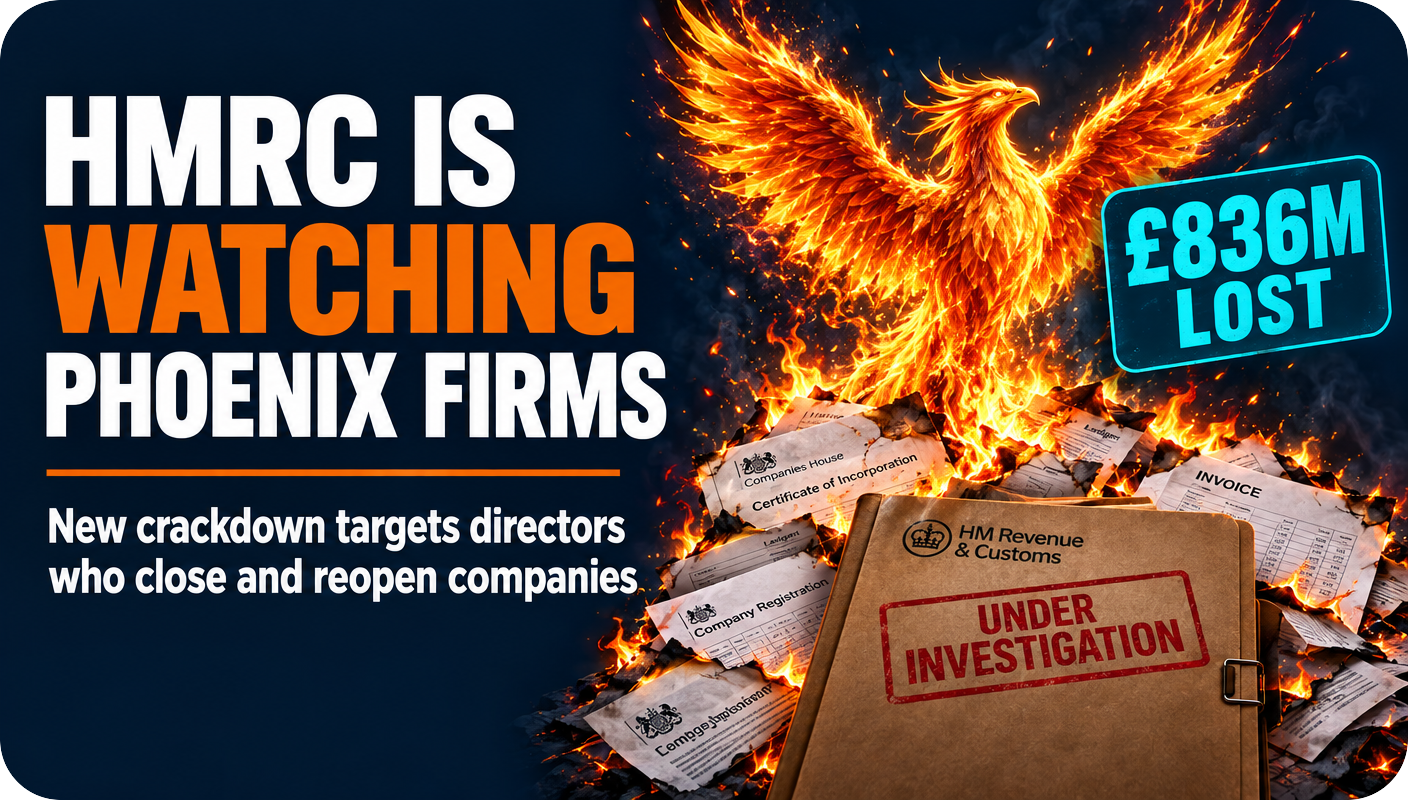
HMRC Is Cracking Down on “Phoenixing” — What Every Ltd Director Needs to Know
If a company is closed owing tax and a near-identical business rises straight away under a new name, HMRC is looking much more closely. Its joint Phoenixism Taskforce is designed to spot deliberate repeat behaviour faster. All figures and rates in this guide are correct as of 13 September 2026.
Key takeaways
- Starting again after a genuine business failure is not automatically illegal.
- The risk is a deliberate tax-avoidance loop: winding up, taking capital treatment, then continuing a similar trade.
- The TAAR can reclassify a liquidation distribution as income, removing the hoped-for tax saving.
- High-risk businesses may be asked for VAT, PAYE and NIC security deposits.
What HMRC means by phoenixing
Phoenixing usually describes a director closing a Ltd company with unpaid tax debts, then setting up a new company carrying on substantially the same trade, often with the same customers. The old company leaves liabilities behind while the new one takes the opportunity forward.
Important context
A business can fail for genuine reasons. Insolvency, closure and a later fresh start are not offences in themselves. HMRC and the Insolvency Service are focused on contrived insolvencies and deliberate, repeated avoidance.
The TAAR: the rule that can undo the tax saving
Liquidation distributions may be taxed as capital rather than dividends. That difference has created an incentive for some directors to wind up and restart. Dividend income can be taxed at up to 39.35%, whereas capital gains rates can be lower. Business Asset Disposal Relief is 18% from April 2026 where the conditions are met.
Under ITTOIA 2005 sections 396B and 404A, the Targeted Anti-Avoidance Rule can apply where a shareholder held at least 5% of a close company, receives a winding-up distribution, carries on a similar trade within two years, and obtaining a tax advantage was one of the main purposes. HMRC can then tax the distribution as income instead of a capital gain.
Warning
Do not assume a Members’ Voluntary Liquidation is a shortcut to lower tax. The facts, timing, ownership, trade and commercial purpose matter. Get advice before taking steps that cannot easily be reversed.
Why the November 2025 crackdown matters
In November 2025, HMRC, the Insolvency Service and Companies House announced a joint strategy against phoenix companies. Their Phoenixism Taskforce combines intelligence across all three bodies and uses AI-assisted analysis to identify repeat patterns faster.
The practical message is simple: records that once sat with separate agencies can now build a clearer picture together. Repeated incorporations, unpaid liabilities, common directors and a continuing trade are more likely to be connected.
Personal liability and security deposits
Where there is a pattern of phoenixing or deliberate evasion, directors may face personal liability for company tax debts. HMRC is also using security deposits more actively for businesses it considers high risk. A deposit can cover future VAT, PAYE and National Insurance liabilities.
Do not ignore a security demand
Continuing to trade after being told to provide a tax security deposit, without paying it, can be a criminal offence. Seek specialist advice immediately and respond within the stated deadline.
What a careful director should do now
Practical next steps
- Bring VAT, PAYE, NIC, Corporation Tax and accounts records up to date.
- Document the genuine commercial reasons for any closure, sale, insolvency or new venture.
- Before liquidation, discuss the TAAR and the intended future trade with a qualified adviser.
- Do not transfer customers, assets or trading activity without proper valuation, records and advice.
- If HMRC contacts you, act promptly and consider HMRC compliance support.
Routine, accurate limited company accounts and timely tax returns are the best starting point. If an enquiry develops, HMRC investigation insurance may also be worth considering for eligible businesses.
How 360Accounts Can Help
Make the next step a compliant one
Whether your company is struggling, you are considering closure, or you simply want reassurance that your records are in order, we can help you understand the tax and compliance position before you act.
Speak to 360Accounts or view our pricing to get started.
Questions directors ask about phoenixing
Is phoenixing always illegal?
No. A genuine closure followed by a later new business can be lawful. The concern is a contrived arrangement designed to leave tax debts behind or secure a tax advantage while carrying on essentially the same trade.
What is the two-year TAAR rule?
One key TAAR condition is that the shareholder carries on a similar trade or activity within two years of the winding-up distribution. It is not the only condition: purpose and the wider facts are also important.
Can HMRC turn capital gains into income tax?
Yes. Where the TAAR applies, HMRC can treat a winding-up distribution as income. This can remove the expected capital gains tax treatment and result in a significantly higher bill.
What is a tax security deposit?
It is a payment or guarantee HMRC may require from a business it considers at risk of not paying VAT, PAYE or NIC. Trading without complying after a notice may have serious consequences.
Could I become personally liable for company tax?
Potentially, particularly where deliberate evasion or a pattern of phoenixing is involved. Take professional advice as soon as a concern arises rather than waiting for enforcement action.
What should I do before winding up my company?
Get tailored tax and insolvency advice, review outstanding liabilities and future plans, and keep clear evidence of the commercial reasons for your decision.