
How Much Should Your Accountant or Bookkeeper Cost?
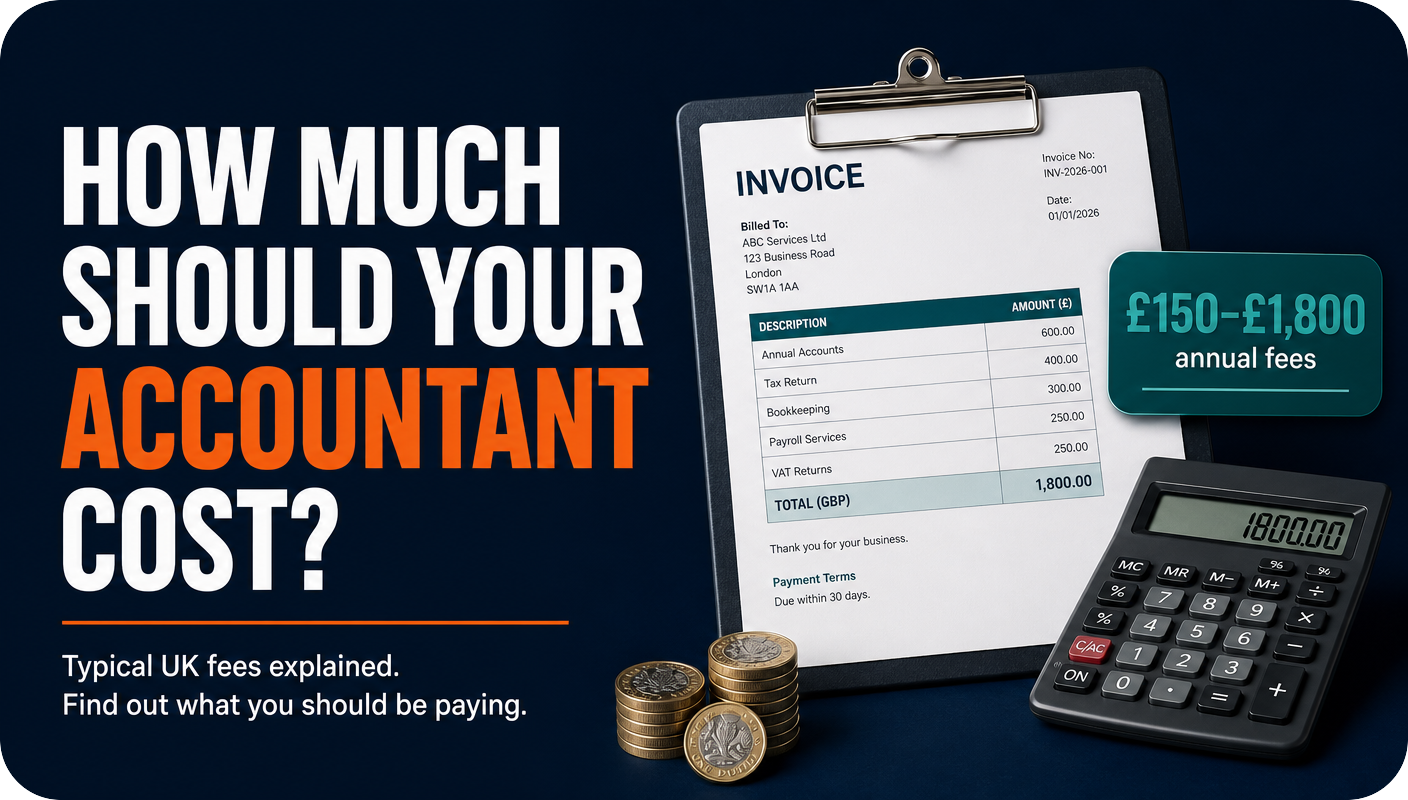
One of the most common questions we hear from small business owners and sole traders is: "How much should I actually be paying for an accountant or bookkeeper?" It is a fair question — fees vary enormously across the UK, and without a clear benchmark it is hard to know whether you are getting good value or simply overpaying. This guide breaks down typical costs, what drives the price, and what to watch out for.
- Accountant and bookkeeper fees in the UK vary widely — from £150/year for a basic self assessment return to over £2,000/year for a full limited company service.
- Fixed monthly packages are usually better value than hourly rates for ongoing work.
- The cheapest option is rarely the best — errors or missed deadlines can cost far more than the saving.
- Location, software, turnover, and complexity all influence price.
- Always ask what is included — many low-cost quotes exclude key services.
Typical UK Accountancy Fees at a Glance
Prices below reflect market rates across the UK in 2026. Costs in the South East (including Surrey and Guildford) often sit at the higher end of these ranges due to local market rates.
What Drives the Price?
Several factors influence what you will pay — and understanding them helps you compare quotes on a like-for-like basis:
- Business structure — Limited companies have more complex compliance requirements than sole traders, so fees are higher.
- Turnover and transaction volume — The more income and expenditure moving through the business, the more work is involved.
- Software — If you use cloud accounting software like Xero or QuickBooks, data is cleaner and faster to process — which can reduce your bill.
- Services included — A cheap quote may cover annual accounts only; a more complete package might include VAT returns, payroll, and ongoing advice.
- Location — Rates in London and the South East are generally higher than the national average.
- Experience and qualifications — A fully qualified accountant (ACA, ACCA, AAT) will typically charge more than an unqualified bookkeeper, but the expertise is usually worth it.
Fixed Fee vs. Hourly Rate — Which Is Better?
Most small business owners prefer a fixed monthly fee — it is predictable, easier to budget for, and often works out cheaper than hourly billing. A fixed package also encourages you to ask questions without worrying about the clock running.
Hourly rates in the UK typically range from £25–£35/hour for bookkeepers and £75–£200/hour for qualified accountants. For one-off pieces of work these can be cost-effective, but for regular monthly services a fixed package is almost always better value.
Sole Traders — What Should You Expect to Pay?
If you are self-employed or a sole trader, your core annual requirement is a Self Assessment tax return. A straightforward return with a single income source typically costs between £150 and £400. If you also need quarterly bookkeeping, VAT returns, or support throughout the year, an all-inclusive fixed monthly package may start from around £50–£100 per month.
With Making Tax Digital for Income Tax (MTD ITSA) arriving for sole traders with income over £50,000 from April 2026, many are now choosing ongoing support packages rather than year-end-only services. Find out more about our sole trader accounts service or our dedicated Self Employed MTD support.
Limited Companies — What Should You Expect to Pay?
Running a limited company carries significantly more compliance obligations — statutory accounts, a Corporation Tax return (CT600), Companies House filing, payroll for directors and staff, and potentially VAT. A comprehensive annual package for a small owner-managed Ltd company typically ranges from £600 to £1,800 per year, though this can be higher for more complex businesses.
Many Ltd company directors split their income between salary and dividends for tax efficiency. A good accountant will advise on the optimal split and help you stay compliant with HMRC. Learn more about our limited company accounts service.
Bookkeeping vs. Accountancy — Do You Need Both?
Bookkeeping involves recording your day-to-day financial transactions — income, expenses, invoices, and bank reconciliation. Accountancy covers the higher-level work: preparing accounts, tax planning, compliance, and strategic advice.
For many small businesses, a single provider who offers both — with bookkeeping services feeding directly into the annual accounts process — is the most efficient and cost-effective solution. It avoids duplication of work and ensures nothing falls through the gaps.
Getting the Best Value
- Ask for a fixed-fee quote that covers all your known requirements — no hidden extras.
- Check qualifications: look for AAT, ACA, or ACCA membership.
- Find out who will actually handle your work — a senior accountant or a junior member of staff.
- Ask about their experience with businesses in your sector.
- Check that they are registered with HMRC as an agent — this enables them to deal with HMRC directly on your behalf.
- Look at transparent pricing pages rather than "contact for a quote" sites where possible.
What Does 360Accounts Charge?
At 360Accounts, we offer clear, fixed-fee packages for sole traders, limited companies, and small businesses across Guildford and Surrey. Our fees are straightforward — no hidden charges, no surprise invoices. You can view our full pricing on our pricing page, or if you would prefer to talk through your specific situation, book a free call with our team.
Questions & Answers
How much does a self assessment tax return cost with an accountant?
For a straightforward sole trader or employed individual with one income source, expect to pay between £150 and £400. More complex returns — with multiple income streams, rental income, or capital gains — will typically fall in the £300–£600+ range. At 360Accounts we offer fixed fees so you always know the cost upfront.
Is it worth paying for a bookkeeper if I am a sole trader?
For many sole traders, yes — especially with Making Tax Digital for Income Tax now requiring quarterly digital submissions for those earning over £50,000. A bookkeeper keeps your records accurate and up to date throughout the year, which means fewer surprises at tax time and a lower accountancy bill overall. Our sole trader packages combine both bookkeeping and tax returns into one clear monthly fee.
What is the difference between a bookkeeper and an accountant?
A bookkeeper records your day-to-day financial transactions — income, expenses, invoices, and bank reconciliation. An accountant handles higher-level work such as preparing statutory accounts, corporation tax returns, tax planning, and compliance advice. Many small businesses benefit from a provider that offers both services under one roof.
How much should a limited company pay for accounting each year?
A comprehensive annual package for a small owner-managed limited company — covering statutory accounts, Corporation Tax return (CT600), Companies House filing, and director payroll — typically ranges from £600 to £1,800 per year. The cost rises with complexity, turnover, number of employees, and whether VAT returns are included. See our limited company accounting service for details.
Are fixed-fee accountants better than hourly-rate accountants?
For most small businesses, yes. A fixed monthly or annual fee is predictable, easier to budget for, and encourages you to ask questions freely without worrying about being charged by the hour. Hourly rates of £75–£200/hour can add up quickly for ongoing work. Check our transparent pricing to see exactly what is included.
How do I know if I am overpaying my accountant?
Compare your current fee against the benchmarks in this guide and request a full breakdown of exactly what is included. If you are paying a premium but not receiving regular advice, proactive tax planning, or prompt responses, it may be worth getting a second opinion. Book a free call with our team to compare what you currently receive against what we offer.
Not sure what you should be paying? Get a clear, no-obligation quote tailored to your business.
Book a Free Call →