
The Late Payment Crisis: What New UK Laws Mean for Your Small Business
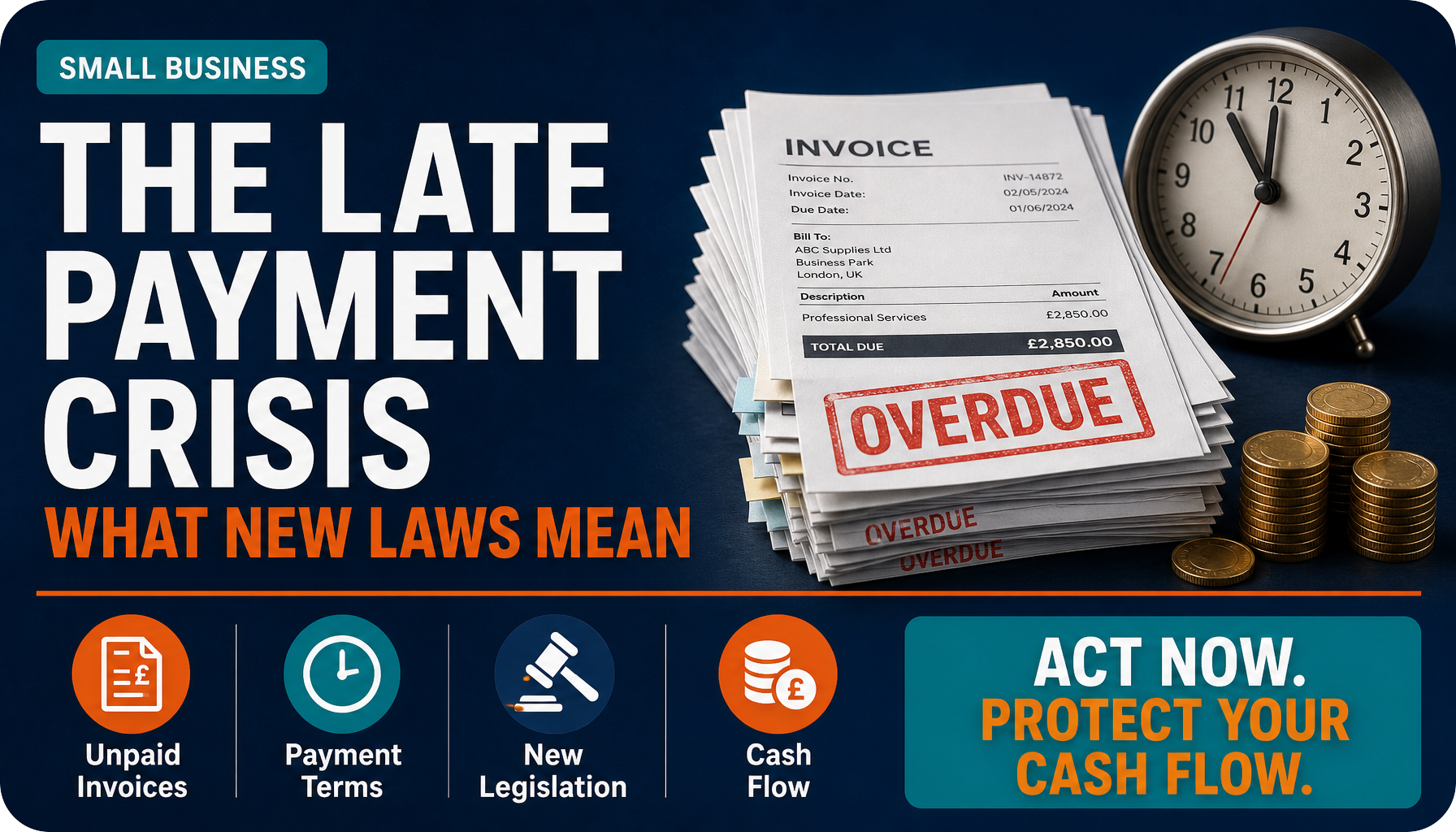
You did the work. You sent the invoice. And then… nothing. Weeks pass, then months. You chase. You get promises. Still nothing. If that sounds painfully familiar, you are far from alone — UK small businesses are collectively owed £26 billion in unpaid invoices right now, and late payments are directly responsible for closing around 38 businesses every single day. The good news is that Parliament has finally decided to act. New legislation is on the way that could fundamentally change how quickly businesses must pay you — and hand real penalties to those who do not.
- UK small businesses are owed £26 billion in unpaid invoices — late payments cost the economy £11 billion a year.
- The Commercial Payments Bill is moving through Parliament, proposing a 60-day cap on payment terms (MPs want 30 days).
- Large companies that persistently pay late could face fines of up to 1% of their UK annual turnover.
- You are already entitled to charge 8% above the Bank of England base rate on overdue invoices — most small businesses never do.
- There are practical steps you can take right now to protect your cash flow, regardless of when the new law kicks in.
The Scale of the Problem
Late payment is not a minor inconvenience — it is a business survival issue. For a sole trader or small business operating on tight margins, a single large invoice sitting unpaid for 90 days can mean missing payroll, delaying supplier payments, or simply running out of cash before the money arrives. The Federation of Small Businesses has described the current environment as a "cost crunch," with energy standing charges reportedly rising 40%, business rates set to increase by 52% over the next three years, and wage costs going up. In that climate, every day an invoice sits unpaid matters.
What the Commercial Payments Bill Actually Does
The Commercial Payments Bill had its first reading in the House of Lords on 19 May 2026. It builds on the 1998 Late Payment of Commercial Debts Act — legislation that is now more than 25 years old and widely seen as having too little bite. The government has described the new regime as the toughest in the G7. Key measures include:
- A 60-day cap on business-to-business payment terms, with very limited exemptions.
- Interest on late payments at 8% above the Bank of England base rate.
- A right to a fixed sum where a customer raises a dispute late or without sufficient information.
- Fines of up to 1% of UK annual turnover for large companies that persistently pay late.
- Board-level reporting requirements — persistent late payers must explain their behaviour in their Directors’ Report.
MPs on the Business and Trade Committee broadly welcomed the Bill, but pushed back on the 60-day cap — arguing that small business owners repeatedly told them 60 days is still too long and that the government should be aiming for 30-day standard terms across the economy. That debate is ongoing, and it is possible the final legislation will be tighter than the current draft.
The new reporting and board-level duties fall on “large” companies — those exceeding at least two of: turnover over £54m, balance sheet over £27m, or more than 250 employees. But the benefits of the new rules apply to everyone who invoices a large business. If your customer is large, they will face penalties for paying you late. And if you are a medium-sized company supplying a large company while also being supplied by smaller firms, you may sit on both sides of this equation at the same time.
What You Can Do Right Now — Before the New Law Passes
The Commercial Payments Bill has not yet become law — implementation timing is still to be confirmed. But waiting for the legislation to pass before tightening your credit control is exactly the wrong move. Here is what you can do today:
- State your payment terms clearly on every invoice — include the due date, not just “30 days.” Courts and debt recovery agents need a specific date.
- Charge statutory interest on overdue invoices — you are already legally entitled to 8% above the Bank of England base rate under the 1998 Act. Most small businesses never claim it. Start mentioning it on your invoices.
- Send payment reminders before the due date — a friendly nudge 3–5 days before the due date dramatically improves on-time payment rates.
- Add a late payment clause to your contracts — make it explicit that interest and a fixed recovery fee will be added to overdue invoices.
- Review your payment terms with large customers — if they currently insist on 90 days, you have a strong argument to bring that down in light of the incoming legislation.
- Separate emotion from the process — chasing payment is a normal business activity. The more systematic you make it, the easier it becomes.
The Cash Flow Reality for Limited Companies
For owner-managed Ltd companies, late payments create a compounding problem. You may have already paid VAT on invoices you have issued — even if the customer has not paid you yet, depending on your VAT accounting method. You may also be meeting payroll obligations for staff while chasing what is effectively your own money. Switching to cash accounting for VAT (available for businesses with turnover under £1.35m) means you only pay VAT when you receive payment, not when you raise the invoice — which can make a meaningful difference to cash flow in a late-payment environment.
Who This Affects Most
This topic is relevant across all business types, but the impact is sharpest for:
- Sole traders and freelancers who rely on a small number of clients — one slow payer can be the difference between a good month and a crisis.
- Small businesses supplying larger companies — the new Bill directly targets the behaviour of large businesses paying their smaller suppliers slowly.
- Ltd company directors managing payroll alongside unpaid client invoices — particularly relevant to those on standard VAT accounting who are effectively pre-funding their clients.
Struggling with late payments or cash flow pressure?
360Accounts helps small businesses, sole traders and Ltd companies in Surrey and Guildford take control of their finances — from bookkeeping and VAT returns to cash flow planning and credit control advice.
Talk to 360Accounts Today