
Mandatory Payrolling of Benefits, What Every Employer Needs to Know Before April 2027
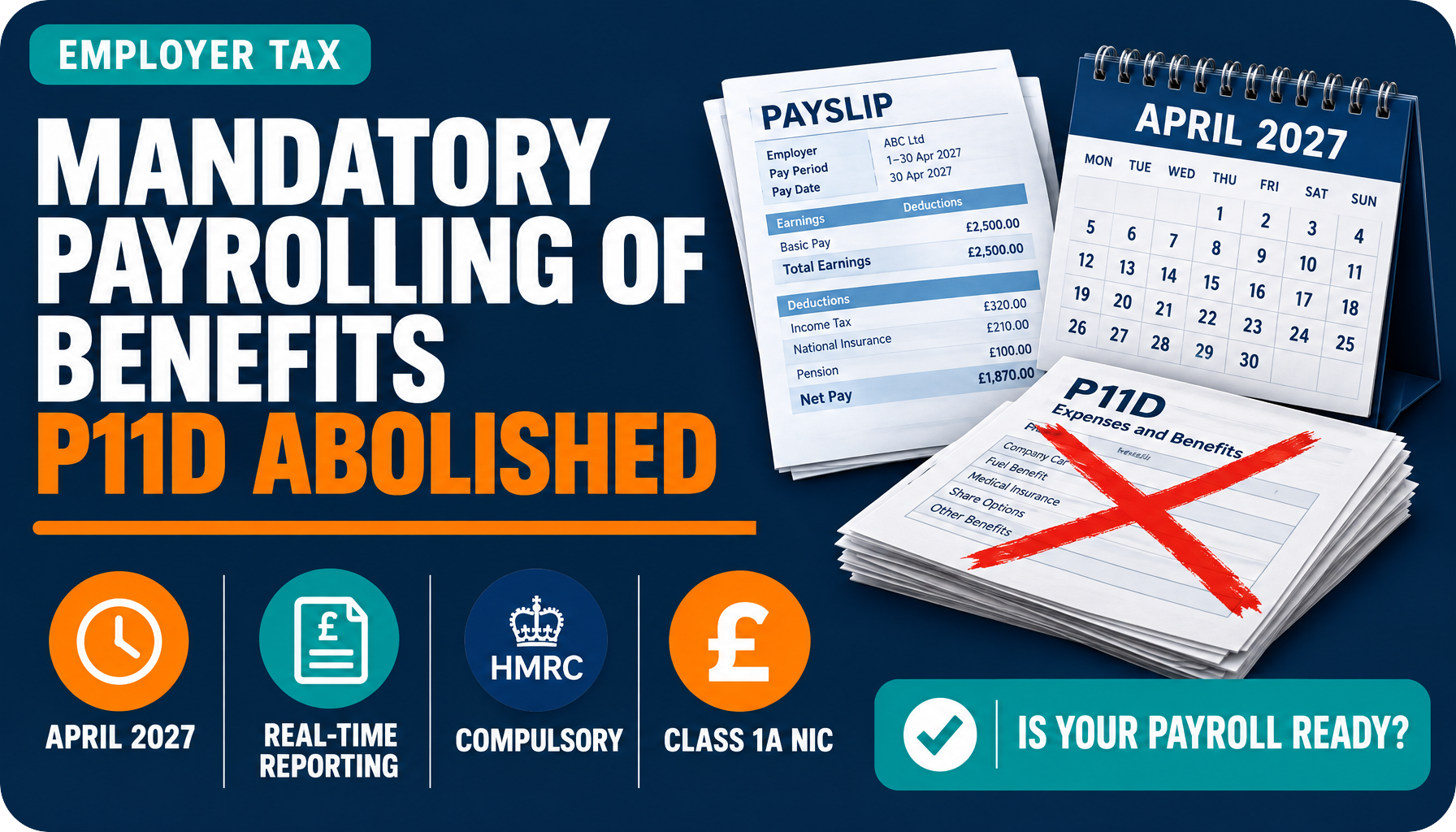
Mandatory Payrolling of Benefits, What Every Employer Needs to Know Before April 2027
The annual P11D is on its way out. From 6 April 2027 employers must start reporting the most common benefits in kind through payroll, in real time, rather than waiting until after the tax year ends. All figures and rates in this guide are correct as of 18 September 2026.
Key takeaways
- Mandatory payrolling was originally due from April 2026, then delayed to April 2027, and HMRC confirmed in June 2026 that it will now be phased.
- Phase one, from 6 April 2027, covers company cars, car fuel, vans, van fuel and employer-provided medical benefits — roughly 80% of all benefits provided.
- Most other benefits follow in phase two from April 2028.
- Beneficial loans and living accommodation stay outside the mandatory regime and will still need a P11D unless you choose to payroll them voluntarily.
- The P11D(b) and Class 1A National Insurance return do not disappear — they are still needed even once benefits are payrolled.
Why the P11D is changing
Under the current system, employers report most benefits in kind on a P11D after the tax year ends, and employees often pay the tax later through a PAYE coding adjustment or self-assessment — sometimes a year or more after they actually received the benefit. HMRC wants tax on benefits collected in real time instead, through payroll, alongside salary.
The change was first announced for April 2026. In April 2025 HMRC pushed the start date back a year to give employers, payroll providers and software developers more time to prepare. Then, on 15 June 2026, HMRC confirmed a further change of approach: rather than moving almost everything across on one date, the rollout will happen in two phases.
Important context
Voluntary payrolling of benefits has been available for years and nothing changes there in the meantime. If you already payroll benefits voluntarily, or want to start doing so for 2026/27, registration with HMRC needed to be in place by 5 April 2026. A separate registration window opens in November 2026 for voluntary payrolling of non-mandatory benefits — including loans and accommodation — from April 2027, closing on 5 April 2027.
What's mandatory, and what stays on the P11D
From 6 April 2027, phase one makes payrolling compulsory for:
- Company cars
- Car fuel
- Company vans
- Van fuel
- Employer-provided medical benefits
Employers do not need to register with HMRC to payroll these mandatory benefits — it simply becomes the required method from that date. HMRC will automatically strip these benefits out of employees' tax codes ahead of April 2027 so they are not taxed twice, though underpayments from earlier years will still sit in the code and continue to be collected.
Most remaining benefits are expected to become mandatory from April 2028 in phase two. Two benefits are carved out permanently from the mandatory regime: employment-related beneficial loans and living accommodation. These will continue to require a P11D each year, unless an employer chooses to payroll them voluntarily.
The P11D(b) is not going anywhere
Even once every eligible benefit is payrolled, the P11D(b) still has a job to do. It is the employer's declaration that reporting is complete and accurate, and the return of Class 1A National Insurance owed. Employers must keep submitting it and pay Class 1A NIC — currently 15% — by the usual 19 July (22 July if paying electronically) deadline.
How employers need to comply
Payrolling in real time means the taxable value of each in-scope benefit is added to pay in every pay period, with income tax and employer Class 1A NIC calculated and reported through RTI as it goes, instead of once a year. That is a meaningfully bigger administrative task than an annual P11D run, and it touches payroll software, HR data flows, benefit providers and employee communications all at once.
Businesses using an external payroll service should confirm now that their provider's systems will handle real-time benefit reporting from April 2027, particularly for benefits that change mid-year such as company car swaps, fuel benefit, or employees joining and leaving. Directors managing their own limited company accounts and payroll in-house have the most work to do, since HMRC's own Basic PAYE Tools will only be updated for BiKs closer to the start date.
Watch the cash flow overlap
Because Class 1A NIC for 2026/27 benefits is still due under the old P11D system in July 2027, at the same time as real-time Class 1A NIC starts being paid for 2027/28 benefits, many employers face two sets of National Insurance liabilities falling due in the same financial year. Build this one-off overlap into your 2027 budgeting now.
Penalties and getting it wrong
HMRC has said it will take a light-touch approach to inaccuracies in real-time benefit reporting for the 2027/28 tax year, so long as there is no evidence of deliberate non-compliance. Late filing and late payment penalties for RTI returns still apply as normal where returns are not sent, or payment is not made, on time, and statutory interest continues to run on late payments. Full detail on the longer-term penalty regime is expected once further draft legislation and guidance is published.
Practical next steps
- List every benefit currently reported on a P11D and check which fall into phase one, phase two, or stay excluded (loans and accommodation).
- Talk to your payroll provider or software supplier now about real-time benefit reporting readiness for April 2027.
- Decide whether early, voluntary payrolling in 2026/27 would help your business test the process before it becomes compulsory.
- Start communicating with employees early — many do not realise they currently pay tax on benefits in arrears, and that will change from April 2027.
- Budget for the one-off Class 1A NIC overlap due in July 2027.
If you're unsure how the changes apply to your business, or want help getting payroll ready ahead of April 2027, speak to 360Accounts or check our pricing for payroll and compliance support.
How 360Accounts Can Help
Get ahead of the April 2027 changes
Whether you need a full payroll service that's ready for real-time benefit reporting, or just want a second opinion on which benefits will be affected, we can help you prepare in good time.
Speak to 360Accounts or view our pricing to get started.
Questions employers ask about payrolling benefits
Is the P11D being abolished completely?
Not entirely. Phase one from April 2027 removes the need for P11Ds on company cars, car fuel, vans, van fuel and employer-provided medical benefits. Phase two, expected from April 2028, is intended to cover most other benefits. Beneficial loans and living accommodation are permanently excluded from the mandatory regime, so a P11D will still be needed for those unless you payroll them voluntarily.
Is the start date April 2026 or April 2027?
Mandatory payrolling was originally planned for April 2026 but HMRC delayed it by a year in April 2025. In June 2026, HMRC confirmed a phased approach starting 6 April 2027 for the highest-volume benefits, with the rest expected to follow from April 2028.
Do employers need to register to payroll mandatory benefits?
No. Registration is not required for the benefits that become mandatory in phase one. Employers who want to voluntarily payroll benefits that remain non-mandatory, such as loans or accommodation, will need to register through a service opening in November 2026, with a deadline of 5 April 2027.
Will the P11D(b) still be needed once benefits are payrolled?
Yes. The P11D(b) declares that reporting is complete and accurate and reports the Class 1A National Insurance due, currently 15%. Employers still need to submit it and pay by the usual July deadline even where every benefit has been payrolled during the year.
Will employees pay more tax under the new system?
Not necessarily more, but sooner. Employees currently often pay tax on benefits a year in arrears through their tax code or self-assessment. From April 2027, tax on in-scope benefits is deducted in the same pay period the benefit is received, which can affect take-home pay and needs clear communication in advance.
What penalties apply if reporting goes wrong?
HMRC has indicated a light-touch approach to inaccuracies for the 2027/28 tax year provided there's no deliberate non-compliance. Standard late filing and late payment penalties, plus statutory interest, will still apply if RTI returns or payments are late. Further penalty guidance is expected as legislation develops.