
Mileage Rate Rises to 55p Per Mile — First Increase in 15 Years: What UK Small Businesses and Sole Traders Must Do Now
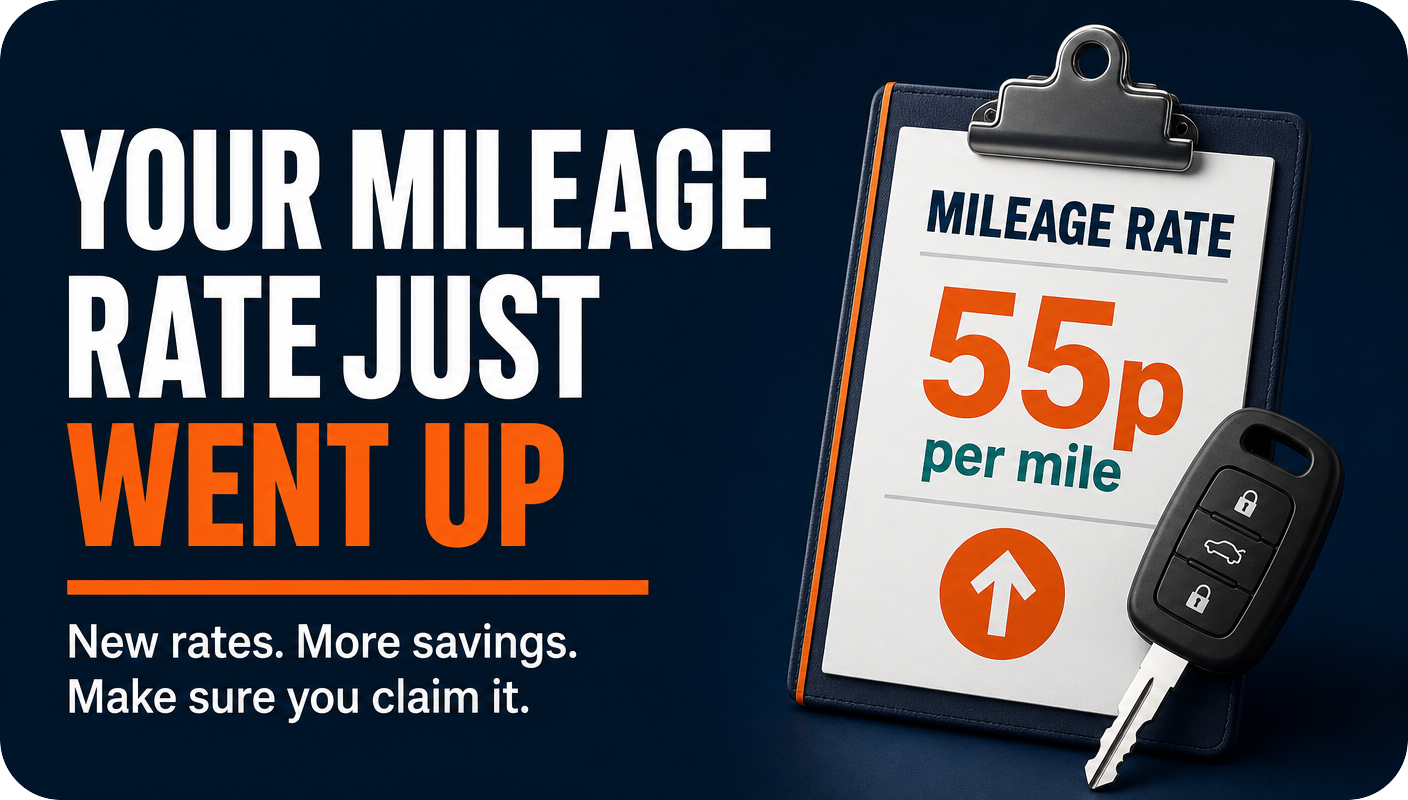
After 15 years with no change, the approved mileage rate for cars and vans has finally risen — from 45p to 55p per mile. Announced on 21 May 2026 as part of the Chancellor's "Great British Summer Savings" package, the increase is backdated to 6 April 2026 and applies to both employees using their own vehicles for business and self-employed sole traders claiming mileage under simplified expenses. If you drive for work and have not yet reviewed your records or payroll, there is money on the table — and action you may need to take before your next submission.
- The HMRC approved mileage rate for cars and vans rises from 45p to 55p per mile — the first increase since 2011.
- The increase applies from 6 April 2026 and is backdated through legislation.
- Sole traders using simplified expenses can now claim 55p per business mile (first 10,000 miles).
- Employers who paid mileage in April or May 2026 at the old 45p rate may need to re-run payroll and pay the difference.
- The rate above 10,000 miles per year remains unchanged at 25p per mile.
What Has Changed and Why
The approved mileage allowance payment (AMAP) rate — the HMRC-sanctioned per-mile figure that can be paid or claimed tax-free — has not moved since 2011. During that period, fuel costs, vehicle running costs, and general living expenses have risen significantly. The government cited the "pressures facing drivers as a result of the effects of the Iran war" as the primary driver of the increase, and the new rate forms part of a broader package of transport-related relief measures.
The approved mileage rate is the per-mile figure HMRC permits employers to reimburse employees — and sole traders to deduct as expenses — without triggering a tax or National Insurance liability. Payments at or below the approved rate are free of income tax and NIC. Payments above the rate trigger a charge on the excess. The rate applies only to business journeys in an employee's or sole trader's own vehicle; it does not apply to company cars.
What This Means for Sole Traders
If you are self-employed and use your own car or van for business journeys, you have two options when claiming expenses: actual costs (fuel, insurance, servicing — apportioned for private use) or simplified mileage expenses. The simplified method allows you to claim a flat rate per business mile driven, which is now 55p for the first 10,000 miles in 2026/27, and 25p for every mile beyond that threshold.
The simplified method is straightforward to use and removes the need to track individual fuel receipts. Many sole traders find it the most practical option, particularly where business and private mileage is mixed. If you have already logged business miles from April 2026 onwards at the old 45p rate, you should recalculate your figures using the new 55p rate before your Self Assessment return.
- Review your mileage log: Ensure you have a clear record of all business journeys from 6 April 2026 onwards, including date, destination, and purpose.
- Recalculate at 55p: If you have been running interim figures at the old rate, update your records to apply 55p per mile from the start of the 2026/27 tax year.
- Check which method you use: If you have been claiming actual costs, compare this against the new simplified rate — for many drivers, 55p per mile will now produce a larger deduction.
- Retain evidence: HMRC may request evidence of business journeys. A simple mileage log with date, start/end points, and business purpose is sufficient.
What Employers Need to Do Now
For businesses that reimburse employees for using their own vehicles, the change has payroll implications that require attention. Where reimbursements were made in April or May 2026 at the old 45p rate, those employees may have been underpaid relative to the new approved amount. Equally, employers who paid above 45p but below 55p during this period have been operating within what was then a taxable excess — which is now within the approved limit.
HMRC has indicated that employers who made payments in excess of the old 45p rate but below the new 55p rate for April and May 2026 will need to re-run their payroll to reflect the retrospective change correctly. HMRC guidance for employers covers the required steps.
If your business paid employee mileage during April or May 2026, you may need to reprocess payroll to account for the backdated rate increase. Failing to do so could result in incorrect PAYE and National Insurance calculations. Speak to your accountant before your next payroll run to confirm whether any corrections are needed.
The Wider Transport Package
The mileage rate increase sits alongside several other government measures announced in May 2026 to ease transport costs:
- Fuel duty cut extended: The existing 5p per litre reduction in fuel duty has been extended until the end of 2026.
- Red diesel duty reduced: The rate of duty on red diesel has been cut by more than a third, from 10.18p to 6.48p per litre, effective 15 June 2026 until the end of the year.
- HGV excise duty holiday: A 12-month vehicle excise duty holiday for the majority of heavy goods vehicles has been introduced.
Taken together, these measures represent meaningful relief for businesses that rely heavily on road transport — including tradespeople, delivery operators, field sales teams, and mobile service providers.
How 360Accounts Can Help
If you are unsure whether the simplified mileage method is right for your business, or you need help recalculating your expenses for the 2026/27 tax year, our team is here to assist. We work with sole traders and small businesses across Surrey and beyond to ensure you claim everything you are entitled to — accurately and on time.
Not sure how the new mileage rate affects your tax position?
Let 360Accounts review your business mileage and expenses — we will make sure you claim the full 55p and structure your records correctly for Self Assessment.