
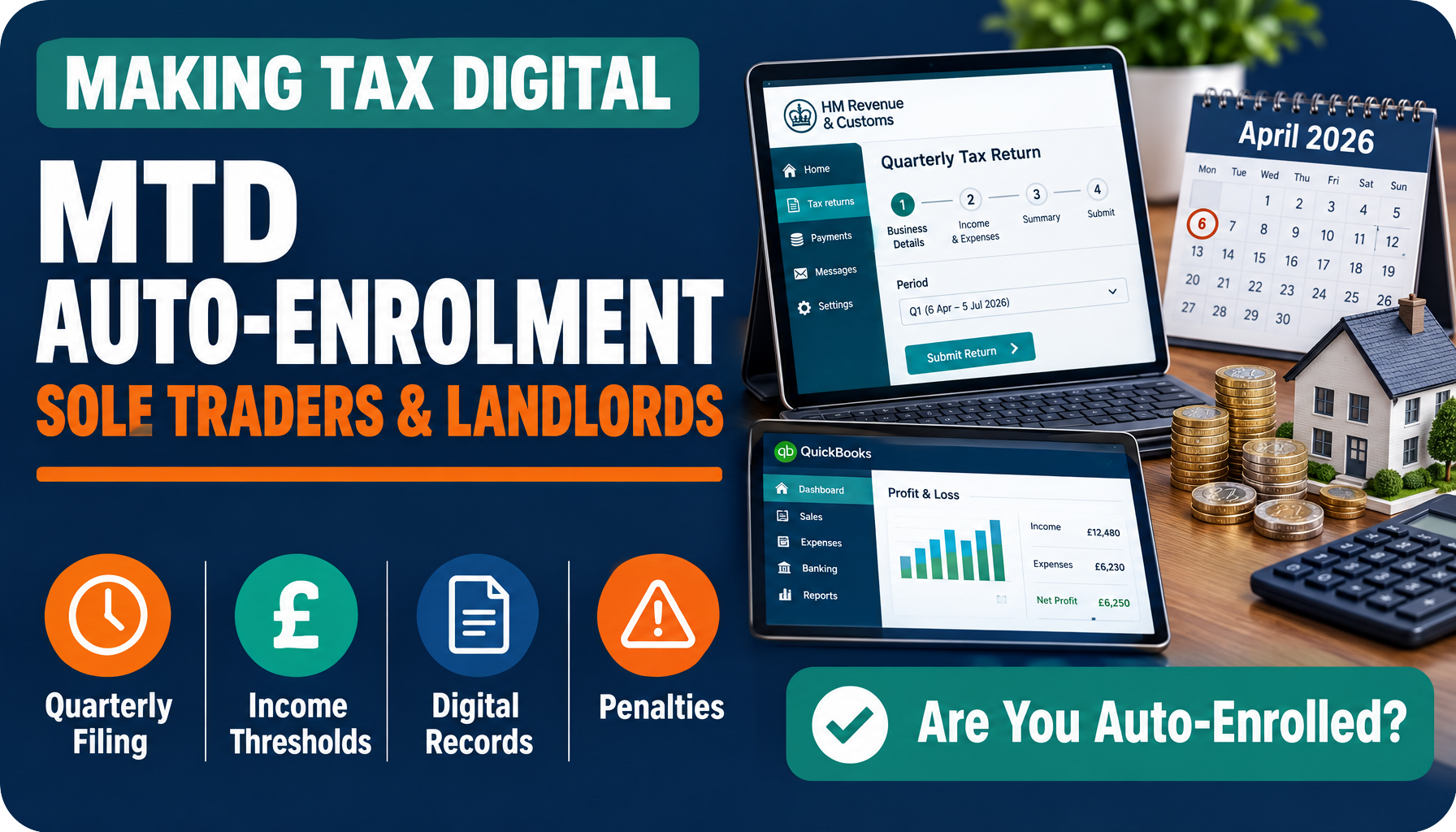
If you're a sole trader or landlord and HMRC has been in touch about Making Tax Digital, you're not alone. HMRC has started auto-enrolling people who earn over £50,000 into MTD for Income Tax Self Assessment (MTD ITSA), and as of 18 September 2026, hundreds of thousands of people have already missed their first quarterly deadline without realising they were affected. This post explains what auto-enrolment means, who's next in line, and what to do if a letter lands on your doormat.
- MTD ITSA became mandatory in April 2026 for sole traders and landlords with qualifying income over £50,000.
- People earning over £30,000 join from April 2027, with a £20,000 threshold proposed to follow later.
- HMRC has already auto-enrolled taxpayers who missed the voluntary registration deadline, whether or not they knew MTD applied to them.
- You need HMRC-recognised software, such as QuickBooks or Xero, to keep digital records and submit quarterly updates.
- Penalties apply for late or missing submissions, so ignoring an HMRC notice is the worst option.
What is MTD auto-enrolment, exactly
MTD ITSA is HMRC's system for reporting self-employment and property income digitally. Instead of one annual tax return, affected taxpayers keep digital records throughout the year, send four quarterly summaries to HMRC, and then complete an annual finalisation to confirm the full picture. It doesn't change how much tax you pay or when you pay it, it changes how and how often you report to HMRC.
Auto-enrolment simply means HMRC has signed you up itself because you meet the qualifying income threshold but hadn't registered voluntarily. You'll get a formal notice, and from that point the quarterly clock starts ticking, whether you feel ready or not.
Who is affected, and when
The rollout is happening in stages based on qualifying income, which is your total income from self-employment and property before expenses, not your profit. As of 18 September 2026, the position is:
- From April 2026: sole traders and landlords with qualifying income over £50,000 must comply.
- From April 2027: the threshold drops to over £30,000.
- Proposed for a later phase: a £20,000 threshold, bringing in many more smaller sole traders and landlords.
If you have more than one source of relevant income, such as a self-employed business and a rental property, your combined income counts towards the threshold. This catches out plenty of people who assumed each income stream would be judged separately.
HMRC has confirmed that as of 18 September 2026, around 428,000 people missed their first quarterly update deadline, and nearly 300,000 hadn't registered at all. Auto-enrolment does not remove your responsibility to check your status, set up compatible software and submit accurate figures on time. If HMRC sends you a notice, read it and act, even if you're convinced it doesn't apply to you.
What compatible software you need
MTD requires digital record-keeping, which means your income and expenses need to be logged in software that's recognised by HMRC and can submit updates directly, or via a bridging tool. Popular options include QuickBooks, Xero and FreeAgent, though you should always check the current HMRC-recognised software list before committing to one.
Our team helps clients set up and run bookkeeping systems that are MTD-ready from day one, including bank feeds and receipt capture, so quarterly submissions become a formality rather than a scramble.
Spreadsheets can still work if paired with an HMRC-recognised bridging tool, but they must maintain digital links between your records and your submission. If you're not confident your current setup meets this bar, it's worth a quick review before your first quarterly deadline arrives.
Quarterly reporting deadlines and what they involve
Once you're in MTD, you'll send four quarterly summaries of income and expenses to HMRC through your software, followed by an annual finalisation at the end of the tax year to confirm the full position and claim any adjustments. The quarterly updates are informational, not a tax payment. You still settle your actual tax bill through the normal Self Assessment timetable.
The key discipline is reconciling your records before each submission. Estimates and gaps in your figures create problems that are far easier to fix quarterly than to untangle at year end.
Penalties for getting it wrong
HMRC operates a points-based penalty system for late submissions. One missed deadline might feel minor, but repeated lateness adds up and becomes genuinely costly. Missing the deadline for your annual finalisation, or submitting inaccurate figures, can also trigger separate penalties.
If illness, a software failure or another genuine reason affects your ability to hit a deadline, contact HMRC or your accountant early. A reasonable excuse is far easier to establish before a deadline passes than after several have piled up.
Who is exempt
Not everyone with qualifying income over the threshold has to join immediately. Some taxpayers can apply for an exemption on the grounds of age, disability, remoteness of location, or an inability to use digital tools for other reasons. HMRC assesses these on a case-by-case basis, so if you think you might qualify, it's worth raising it directly rather than assuming you're covered.
What to do now
- Work out your qualifying income across all self-employment and property sources, and check whether you're already within scope or due to join from April 2027.
- Read any HMRC notice carefully, even if you weren't expecting one. Auto-enrolment happens automatically once you cross the threshold.
- Choose HMRC-recognised software and set up your digital records properly, rather than trying to catch up after your first deadline.
- Register for MTD and authorise your software or your accountant to submit on your behalf. Existing Self Assessment registration does not automatically cover MTD.
- Build a quarterly routine for reconciling records well before each deadline, rather than leaving it to the last minute.
If any of this sounds like a headache you'd rather hand over, that's exactly what we're here for. Read more about our practice, and get in touch when you're ready.
Questions and answers
Does MTD replace Self Assessment
No. MTD adds digital record-keeping and quarterly reporting on top of your existing obligations. You still complete the year-end process and pay any tax due through the normal Self Assessment timetable.
Who had to start in April 2026
Sole traders and landlords with qualifying income over £50,000 were the first group brought into MTD ITSA. Qualifying income is based on total income from self-employment and property, not profit, so check the current HMRC guidance if you're close to the line.
When do people earning over £30,000 join
The staged rollout brings in taxpayers with qualifying income over £30,000 from April 2027. A further threshold of £20,000 has been proposed for a later phase. Preparing in advance is far less stressful than waiting for an HMRC reminder.
Can I use QuickBooks or Xero
Yes, QuickBooks, Xero and FreeAgent are all commonly used for MTD submissions. Always verify that your specific product and plan are compatible with the type of submission you need to make, as features vary between packages.
Can I keep paper receipts
You can retain paper evidence, but the accounting records themselves must be kept digitally and linked appropriately to the figures you submit. Keep reliable backups and a clear audit trail so figures can be explained if HMRC asks questions.
What happens if I miss a quarterly deadline
Penalties can apply for late or missing submissions under HMRC's points-based system. Submit as soon as possible, check your penalty position, and contact HMRC or your adviser promptly if you have a reasonable excuse.