
MTD for Income Tax: Your First Quarterly Deadline Is 7 August 2026
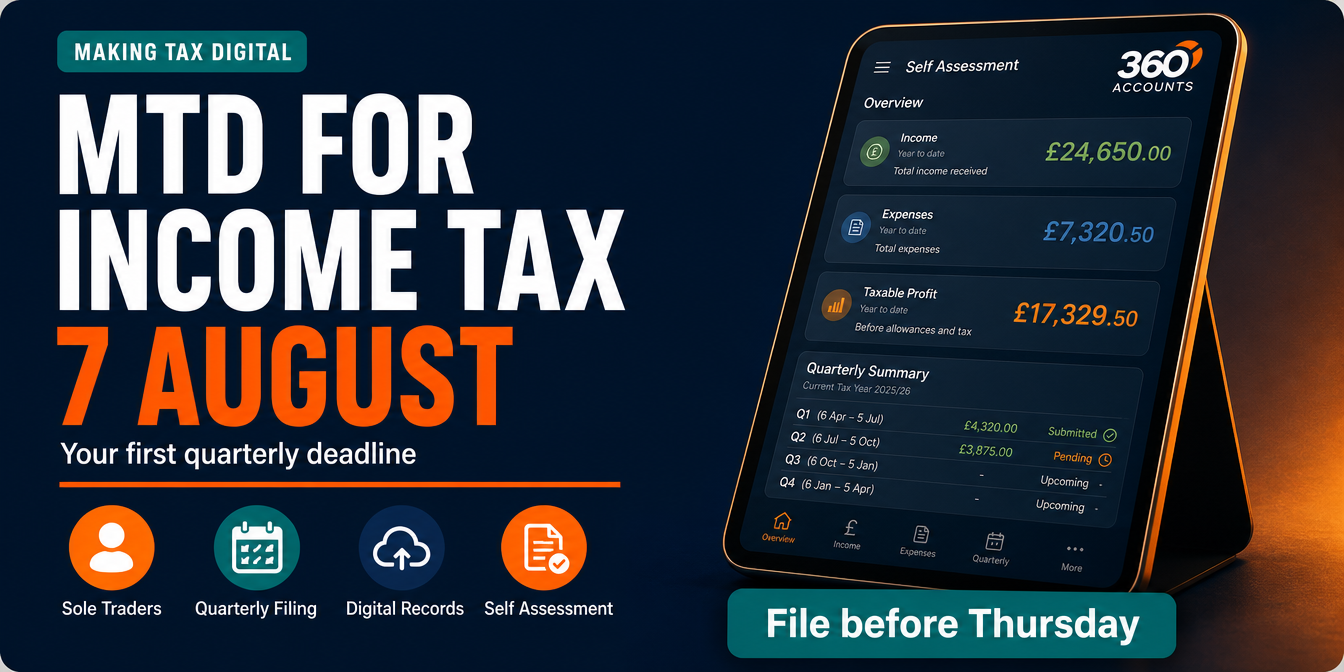
As of 4 August 2026, sole traders and landlords with income over £50,000 are just days away from their first Making Tax Digital (MTD) for Income Tax quarterly deadline. MTD for Income Tax went live in April 2026 for this group, and the first quarterly update — covering income and expenses from 6 April to 5 July 2026 — is due to HMRC by 7 August 2026. If you fall into this group and haven't yet submitted, this guide explains exactly what's required and how to stay compliant.
- Sole traders and landlords earning over £50,000 must now submit quarterly updates under MTD for Income Tax.
- The first quarterly period (6 April – 5 July 2026) must be submitted to HMRC by 7 August 2026.
- A quarterly update is a summary of income and expenses — not a full tax return — submitted using HMRC-recognised MTD software.
- Missing deadlines can trigger HMRC's points-based late submission penalty system.
- The threshold drops to £30,000 from April 2027, bringing many more sole traders and landlords into scope.
What Is MTD for Income Tax?
Making Tax Digital for Income Tax is HMRC's digital tax reporting system for self-employed individuals and landlords. Rather than filing one Self Assessment return each January, affected taxpayers must keep digital records and submit a quarterly update to HMRC throughout the year, followed by a final declaration after the tax year ends. It applies alongside — and is gradually replacing key parts of — the traditional Self Assessment process. For anyone already using our bookkeeping services, most of the groundwork is already in place; for everyone else, now is the time to get digital records set up properly.
Who Is Affected Now — and Who's Next
As of 4 August 2026, MTD for Income Tax applies to sole traders and landlords with qualifying income over £50,000, based on the income reported in their 2024/25 Self Assessment return. This includes self-employed individuals under our Self Employed (MTD) service and landlords with rental income covered by our property accounts service. Limited company directors are not directly affected by MTD for Income Tax, but any director with significant sole trader or rental income alongside their company should check whether they personally cross the threshold.
What You Need to Submit
A quarterly update is far simpler than a full tax return. It is a running summary of your business or property income and allowable expenses for the three-month period, submitted directly from MTD-compatible software connected to HMRC's systems. You are not calculating your final tax bill at this stage — that happens later, after your fourth quarterly update, when you submit an End of Period Statement and a Final Declaration.
- Income — all business or rental income received in the quarter
- Expenses — allowable costs incurred wholly for the business or property
- Digital record-keeping — records must be kept digitally throughout the quarter, not reconstructed at the deadline
Compatible Software
Quarterly updates must be submitted using HMRC-recognised MTD for Income Tax software. This typically means cloud accounting platforms such as QuickBooks or Xero, or dedicated MTD bridging tools, all of which connect directly to HMRC's Making Tax Digital service. Spreadsheets can still be used for record-keeping if paired with approved bridging software, but a fully digital, connected system is by far the most reliable route. Our accounting software service can get you set up with the right platform and ensure it is correctly linked to HMRC ahead of future deadlines.
What Happens If You Miss the Deadline
HMRC applies a points-based penalty system for late submissions under MTD for Income Tax. Each missed quarterly update or Final Declaration adds a point to your record; once you reach the relevant threshold, a fixed financial penalty is triggered, and further missed deadlines can lead to additional escalating penalties. Late payment of any tax owed carries separate penalties and interest on top. Persistent non-compliance also increases the likelihood of closer HMRC scrutiny. If you've received correspondence from HMRC about a compliance check, our HMRC investigations and compliance support service can help you respond correctly.
What's Coming Next
As of 4 August 2026, the £50,000 threshold applies for the 2026/27 tax year. From April 2027, the threshold drops to £30,000, bringing a significantly larger number of sole traders and landlords into MTD for Income Tax. A further reduction to a £20,000 threshold has been signalled by the government for a later date, though this is not yet confirmed. If your income sits below £50,000 today but above £30,000, you should start preparing digital records now rather than waiting until the rules apply to you.
How 360 Accounts Can Help
Whether you're already submitting your first quarterly update or preparing for the £30,000 threshold in 2027, 360 Accounts can set up compliant digital record-keeping, connect the right MTD software, and manage your quarterly submissions on your behalf. Our sole trader accounts and property accounts services are built around the MTD requirements, so you never miss a deadline or scramble for records at the last minute.
Don't risk a penalty on your first MTD deadline.
Talk to 360 Accounts today and let us handle your quarterly submissions, digital records and HMRC compliance.
Book a Free CallFrequently Asked Questions
Do I still need to file a Self Assessment tax return under MTD for Income Tax?
Not in the traditional sense. Once you're in MTD for Income Tax, quarterly updates plus an End of Period Statement and Final Declaration replace the old annual Self Assessment return, though the underlying obligation to declare and pay the right tax remains the same.
What if my income fluctuates and I'm not sure if I'm over £50,000?
HMRC bases your inclusion on the qualifying income reported in your 2024/25 Self Assessment return. If you were close to the threshold, it's worth checking your notice from HMRC or speaking to your accountant to confirm your status.
Can I use a spreadsheet instead of accounting software?
Only if it's paired with HMRC-recognised bridging software that can transmit the data digitally. A standalone spreadsheet with manual re-entry into HMRC's portal does not meet the digital record-keeping requirement.
What exactly counts as the first quarterly period?
For most affected taxpayers, the first standard quarter runs from 6 April 2026 to 5 July 2026, with the update due by 7 August 2026. Some taxpayers may have elected for calendar quarters instead — check your HMRC MTD notice to confirm which applies to you.
What happens after all four quarterly updates for the year are submitted?
After the fourth quarterly update, you submit an End of Period Statement for each business or property source, followed by a Final Declaration confirming your total income and any other tax matters, similar in role to the old Self Assessment return.
I'm a landlord earning £40,000 in rental income — do I need to worry yet?
Not for the current £50,000 threshold, but from April 2027 the threshold falls to £30,000, which would bring you into scope. It's sensible to start keeping digital records now so the transition is seamless when the rules apply to you.