
MTD Income Tax: Your First Quarterly Deadline is 7 August 2026
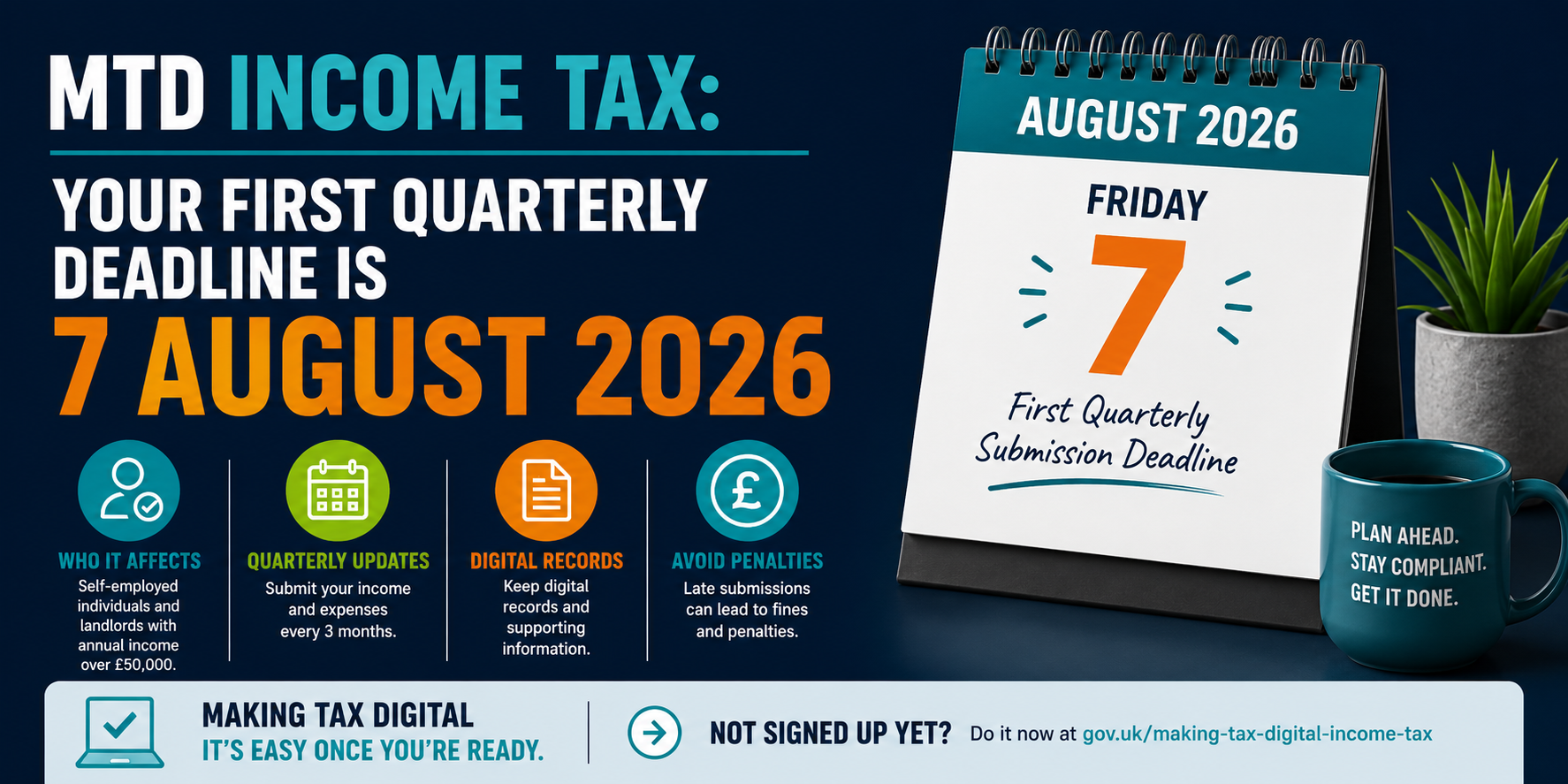
HMRC issued an official reminder this week: if you are a sole trader or landlord earning more than £50,000 a year, your first Making Tax Digital (MTD) for Income Tax quarterly update is due by 7 August 2026. MTD for Income Tax has been live since 6 April 2026, and the clock is ticking on that first filing. If you have not yet signed up or organised your digital records, now is the time to act — not in late July when things get frantic.
- MTD for Income Tax is mandatory from 6 April 2026 for sole traders and landlords with qualifying income over £50,000.
- The first quarterly update covers 6 April to 5 July 2026 and must be submitted by 7 August 2026.
- Each quarterly update is cumulative — it covers income and expenses from the start of the tax year, not just the previous three months.
- You do not need expensive accounting software — HMRC allows digital spreadsheets with bridging software.
- Over 100,000 taxpayers have still not registered. If that includes you, there is still time — but act now.
What Is MTD for Income Tax and Who Does It Affect?
Making Tax Digital for Income Tax replaces the traditional once-a-year Self Assessment return for eligible individuals. Instead of filing one return each January, you now submit quarterly updates of your income and expenses through HMRC-recognised software, then complete a final declaration at the end of the tax year.
- From 6 April 2026 — sole traders and landlords with qualifying income above £50,000
- From 6 April 2027 — those with qualifying income above £30,000
- From 6 April 2028 — those with qualifying income above £20,000
Qualifying income includes earnings from self-employment and UK property rental, combined. If your total from both sources exceeds the threshold, MTD applies to you.
How the Quarterly Update System Works
One of the most common points of confusion around MTD is how quarterly updates are structured. They are cumulative — each submission covers the running total from the start of the tax year, not just the three months that have just passed. So your Q1 update (due 7 August) covers April to June. Your Q2 update (due 7 November) covers April to September. And so on.
This means that if you spot an error in your Q1 figures, you can correct it in your Q2 submission without re-sending Q1 separately. HMRC confirmed this approach to give businesses more flexibility throughout the year.
Here is the full schedule of quarterly update deadlines for the 2026–27 tax year:
- Q1 (6 April – 5 July): due by 7 August 2026
- Q2 (6 April – 5 October): due by 7 November 2026
- Q3 (6 April – 5 January): due by 7 February 2027
- Q4 (6 April – 5 April): due by 7 May 2027
- Final declaration (tax return): due by 31 January 2028
- Check your eligibility — use the HMRC tool at gov.uk to confirm whether your qualifying income exceeds £50,000.
- Choose your software — HMRC maintains a list of approved MTD-compatible software, including free options for straightforward affairs.
- Sign up for MTD — registration takes around 3 minutes via your Government Gateway account.
- Keep digital records — record your income and expenses digitally as you go. Spreadsheets are allowed, provided they connect to HMRC via bridging software.
- Speak to your accountant — if you work with an agent, make sure they are set up and ready to submit on your behalf.
Do You Need to Buy Expensive Software?
Many business owners have been worried that MTD means they must subscribe to a full accounting platform such as Xero or QuickBooks. That is not the case. HMRC explicitly permits the use of spreadsheets — such as Excel or Google Sheets — combined with approved bridging software that connects your records to HMRC’s systems. You do not need to change how you manage your books if your records are already kept digitally.
HMRC has confirmed it will not apply penalty points for late quarterly updates during the first year of MTD (2026–27). However, this grace period does not mean you can ignore the requirement. Getting signed up, choosing your software, and organising your digital records now will prevent a stressful scramble in July. More than 100,000 taxpayers have still not registered — do not be one of them when the deadline arrives.
How 360Accounts Can Help
At 360Accounts, we have been preparing our clients for MTD for Income Tax since well before it became mandatory. Whether you are a sole trader managing your own books or a landlord with multiple properties, we can guide you through every step — from registration and software selection to submitting your quarterly updates on time.
Need help getting MTD-ready?
Our team is here to take the stress out of Making Tax Digital. Get in touch today and we will make sure you are set up correctly before the 7 August deadline.
Get in Touch with 360Accounts