
MTD for Income Tax: Your First Quarterly Deadline Is 7 August 2026
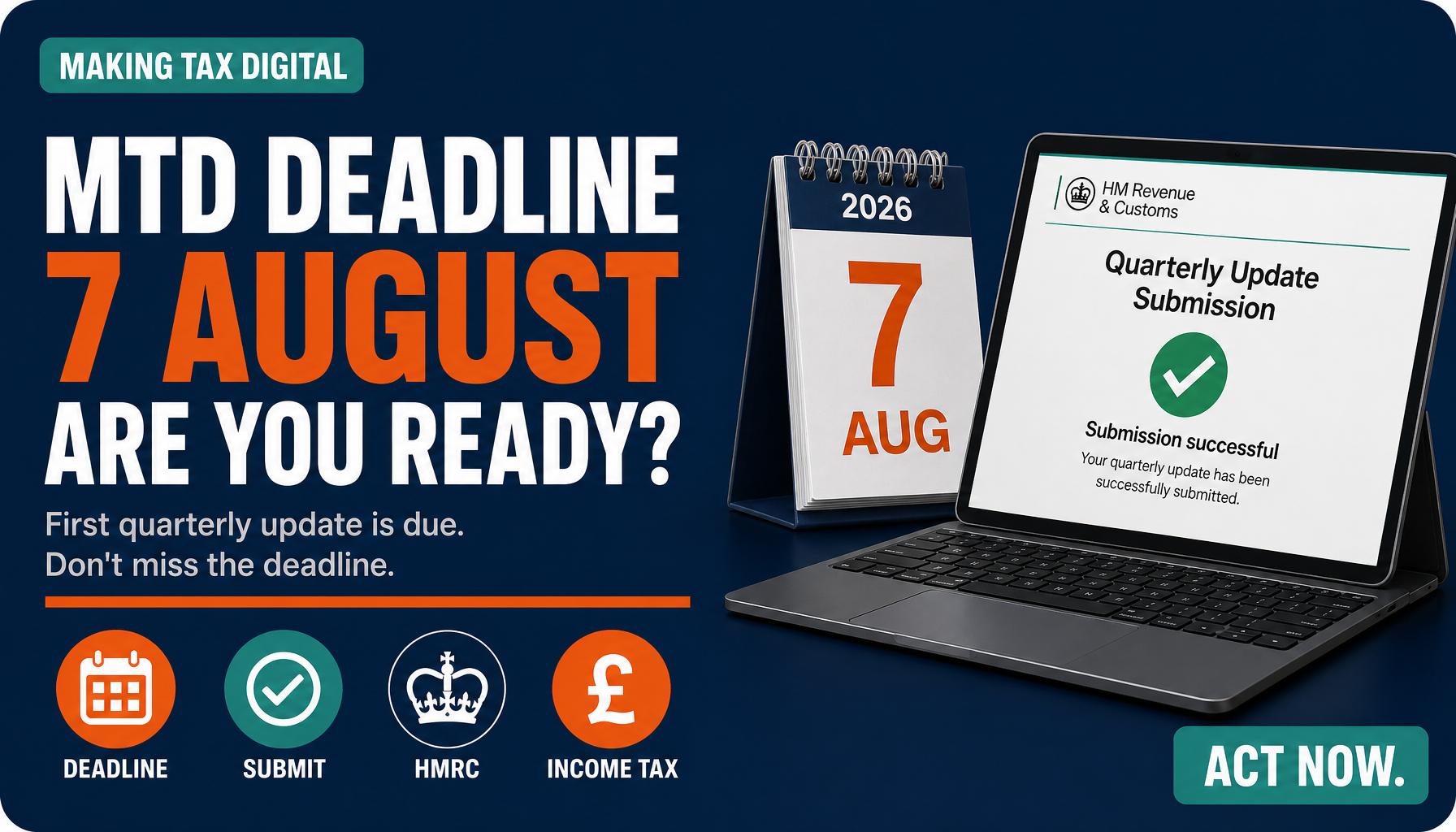
Today, 5 July 2026, marks the end of the very first quarterly reporting period under Making Tax Digital for Income Tax Self Assessment (MTD for Income Tax). If you are a self-employed sole trader or a landlord with gross income above £50,000, your first quarterly update to HMRC is now due — and you have until 7 August 2026 to submit it. This is not a soft deadline. It is the first live, mandatory submission date under the biggest overhaul to UK income tax reporting in a generation, and missing it could result in penalty points.
- MTD for Income Tax launched on 6 April 2026 for sole traders and landlords earning over £50,000 per year.
- The first quarterly period ran from 6 April to 5 July 2026 — it ends today.
- Your first quarterly update must be submitted to HMRC by 7 August 2026.
- You must use HMRC-approved MTD-compatible software — spreadsheets and manual records alone are no longer acceptable.
- The income threshold drops to £30,000 from April 2027, bringing many more people into the regime.
What Is Making Tax Digital for Income Tax?
Making Tax Digital (MTD) for Income Tax Self Assessment replaces the traditional once-a-year Self Assessment tax return for eligible individuals. Instead of filing everything in January, you now report your income and expenses to HMRC in four quarterly updates throughout the year, plus a final end-of-year declaration to reconcile the figures.
- Quarter 1: 6 April – 5 July 2026 — submission due by 7 August 2026
- Quarter 2: 6 July – 5 October 2026 — due by 7 November 2026
- Quarter 3: 6 October – 5 January 2027 — due by 7 February 2027
- Quarter 4: 6 January – 5 April 2027 — due by 7 May 2027
- End-of-year declaration: due by 31 January 2028
Each quarterly update is a summary of your business income and expenses for that period — submitted digitally through MTD-compatible software directly to HMRC.
Who Is Affected Right Now?
From 6 April 2026, MTD for Income Tax applies to sole traders and landlords whose gross income (before any expenses are deducted) exceeds £50,000 per year. This covers income from self-employment, rental property, or both combined. If your combined qualifying income crosses the threshold, you are in scope.
From April 2027, the threshold drops to £30,000, drawing a significant number of additional sole traders and smaller landlords into the regime. General partnerships are expected to follow in April 2028, with other entities phased in thereafter.
The £50,000 threshold applies to your gross turnover or rental income — not your taxable profit after expenses. A sole trader invoicing £55,000 but with £20,000 in allowable expenses is still within scope, even though their profit is only £35,000. If you are unsure whether you are affected, speak to your accountant now.
What You Need to Do Before 7 August
If you are already registered for MTD for Income Tax and using compatible software, your immediate task is to compile and submit your Quarter 1 update by 7 August. Here is what that involves:
- Gather your records: Collect all income received and expenses paid between 6 April and 5 July 2026.
- Categorise expenses: Use the correct HMRC expense categories in your MTD software — for example, office costs, travel, stock, professional fees.
- Check your software: Log into your MTD-compatible accounting package and ensure your records are complete and reconciled.
- Submit the quarterly update: Use your software to send the summary directly to HMRC before 7 August 2026.
- Keep digital records: All income and expense records must now be maintained digitally — paper records alone are not sufficient under MTD rules.
What If You Are Not Yet Signed Up?
If your income is above £50,000 and you have not yet registered for MTD for Income Tax, you should act immediately. HMRC has been issuing communications to eligible taxpayers, and over 350,000 businesses have already signed up. The regime is not optional for those who qualify — late registration and late submissions may trigger the new penalty points system.
- Step one: Check whether your gross income for the previous tax year exceeded £50,000. Use your 2024–25 Self Assessment return as the reference point.
- Step two: Choose and set up an HMRC-approved MTD-compatible software package. HMRC publishes a list of approved providers on GOV.UK.
- Step three: Register for MTD for Income Tax through your Government Gateway account or GOV.UK One Login.
- Step four: Migrate your existing records into the new system and submit your Quarter 1 update as soon as possible.
MTD for Income Tax uses a points-based penalty system. Each missed quarterly submission earns a penalty point. Once you reach four points, a £200 fine is issued — and further fines follow for each subsequent failure. The points system is designed to be lenient on occasional lapses but firm on persistent non-compliance. Getting set up properly now avoids this entirely.
How 360Accounts Can Help
The move to MTD for Income Tax changes the rhythm of your tax reporting — but it does not have to mean more work for you. At 360Accounts, we work with sole traders, landlords, and small business owners across Guildford and Surrey to make the transition as straightforward as possible. We can help you choose the right software, set up your digital records, and handle your quarterly submissions throughout the year so you never miss a deadline.
Ready to get MTD sorted before the 7 August deadline?
Speak to the team at 360Accounts today. We will check whether you are in scope, help you choose compatible software, and make sure your first quarterly update is filed correctly and on time.
Get in Touch →