
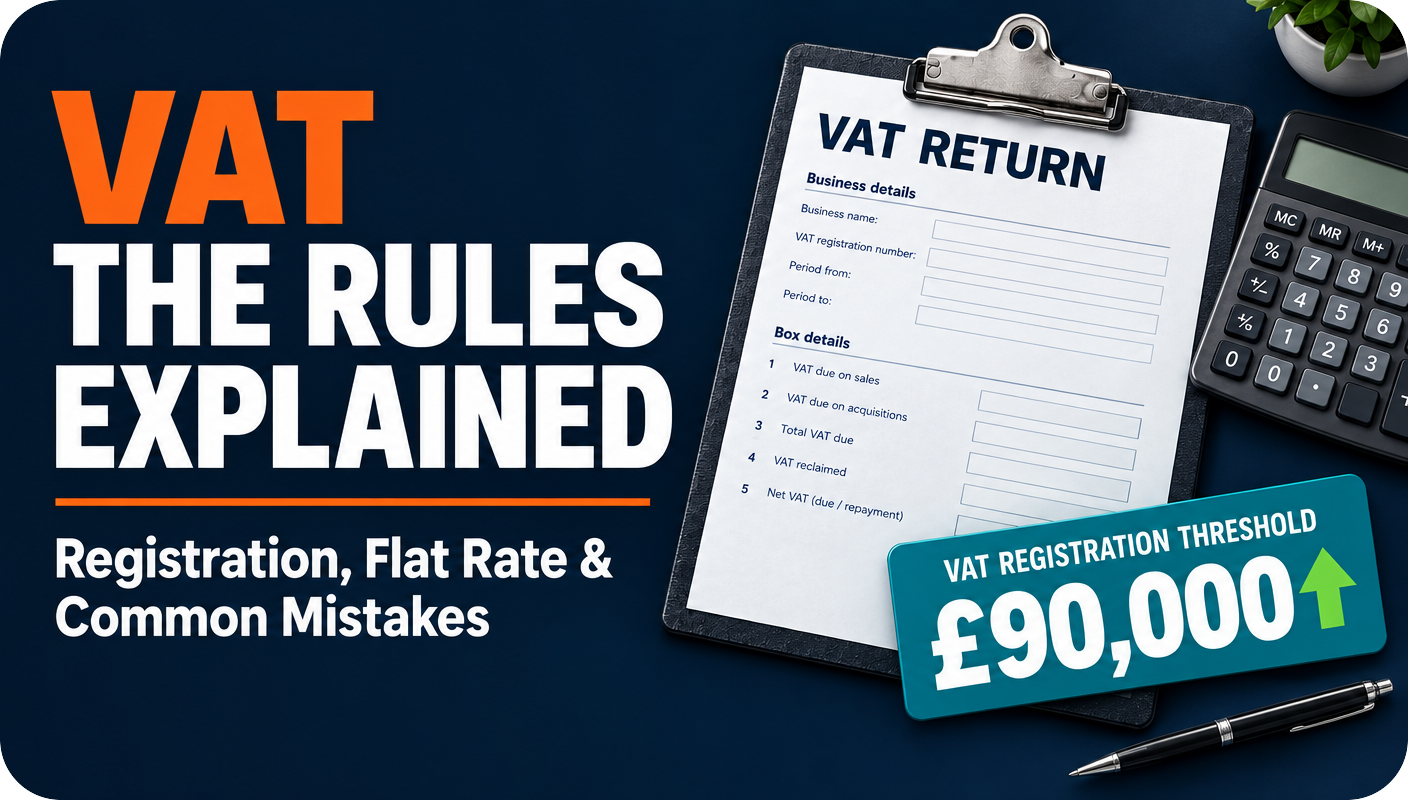
VAT Registration, the Flat Rate Scheme, and the Mistakes That Catch Businesses Out
As of 19 September 2026, VAT is still one of the areas where small businesses trip up most — usually not because the rules are complex, but because deadlines and thresholds get overlooked while you're busy running the business. Here's what matters on registration, the Flat Rate Scheme, and the mistakes we see most often.
- The VAT registration threshold is £90,000 of taxable turnover in any rolling 12 month period.
- You must register within 30 days of exceeding the threshold, or expecting to.
- The Flat Rate Scheme suits businesses with turnover of £150,000 or less, using a fixed percentage rate.
- Late registration, the wrong scheme, and poor record keeping are the three costliest mistakes.
- Making Tax Digital rules require digital records and compatible software for almost everyone VAT registered.
When Do You Need to Register?
You must register once taxable turnover for the previous 12 months passes £90,000, or if you expect it to in the next 30 days alone. It's a rolling test, not a tax year test, so check regularly rather than only at year end. Voluntary registration below the threshold is also an option, useful for reclaiming VAT on purchases or looking established to VAT registered clients.
How the Flat Rate Scheme Works
Instead of tracking VAT on every purchase and sale, you apply a fixed percentage (set by your trade) to gross turnover and keep the difference. You can join with turnover of £150,000 or less (excluding VAT), and must leave once it exceeds £230,000. There's a 1% discount in your first year registered.
The scheme suits businesses with low costs relative to turnover, such as many service providers. Businesses spending heavily on VAT-able stock often do better under standard VAT accounting instead. Watch for the "limited cost trader" rate of 16.5%, which applies if goods spend is very low — this catches out service businesses expecting their normal sector rate.
Making Tax Digital and Your Records
MTD for VAT requires almost all VAT registered businesses to keep digital records and file through compatible software, with a digital link from records to return. Good bookkeeping and the right accounting software make this straightforward from the outset.
Common VAT Mistakes We See
Late registration is the most expensive, meaning VAT owed from your own pocket for months you never charged it. The wrong scheme is the most avoidable — a simple calculation many skip. Poor record keeping is the most persistent, causing errors every quarter: missing invoices, VAT claimed on ineligible purchases, and periods that don't match your software settings.
Frequently Asked Questions
What happens if I register for VAT late?
HMRC backdates your liability to the date you should have registered, so you owe VAT on sales during that period even though you never charged it, plus a lateness penalty. Registering as soon as you spot the issue is always cheaper than waiting.
Can I register voluntarily below the threshold?
Yes. It lets you reclaim VAT on purchases and can make you look more established to VAT registered clients. The trade-off is charging VAT on your own sales, making you pricier to customers who can't reclaim it, such as the public. Whether it's worth it depends on who buys from you.
Is the Flat Rate Scheme always cheaper?
No. It suits businesses with low costs relative to turnover, since you don't reclaim VAT on individual purchases. Businesses with significant VAT-able expenses, such as stock or subcontractors, often do better under standard VAT accounting. It depends on your figures, not your trade sector alone.
What is a limited cost trader?
A Flat Rate Scheme business whose goods spend is very low, typically under 2% of turnover. If this applies, HMRC requires the 16.5% rate regardless of your sector, considerably higher than most sector rates. Many consultants and freelancers get caught out assuming their advertised sector rate applies.
Do I need MTD software on the Flat Rate Scheme?
Yes. MTD requirements apply regardless of scheme. Records must be kept digitally and returns filed through compatible software, with an unbroken digital link from your original data to the return. Manual re-entry between spreadsheets breaks that link, so set software up properly from the start.
How often should I check my VAT turnover?
Ideally monthly. As it's a rolling 12 month test rather than a fixed tax year check, a strong month can push you past £90,000 well before your annual accounts would flag it. Seasonal businesses or those with a few large contracts are most at risk of crossing the line unnoticed.
Not sure whether you need to register for VAT, or which scheme suits your business?
Our VAT services team can review your figures and get everything set up correctly, first time.
Get in Touch