
What Can I Claim as a Business Expense?
Knowing what you can claim as a business expense keeps your tax bill fair and your records tidy. Whether you are a sole trader, a small business owner or a limited company director, the key test is simple: the cost must be for business, not private use. This guide reflects HMRC rules and rates as of 18 September 2026.
Key takeaways
- Claim costs that are wholly and exclusively for your business, keeping a receipt or other supporting record.
- Private spending, drawings and most client entertaining are not allowable.
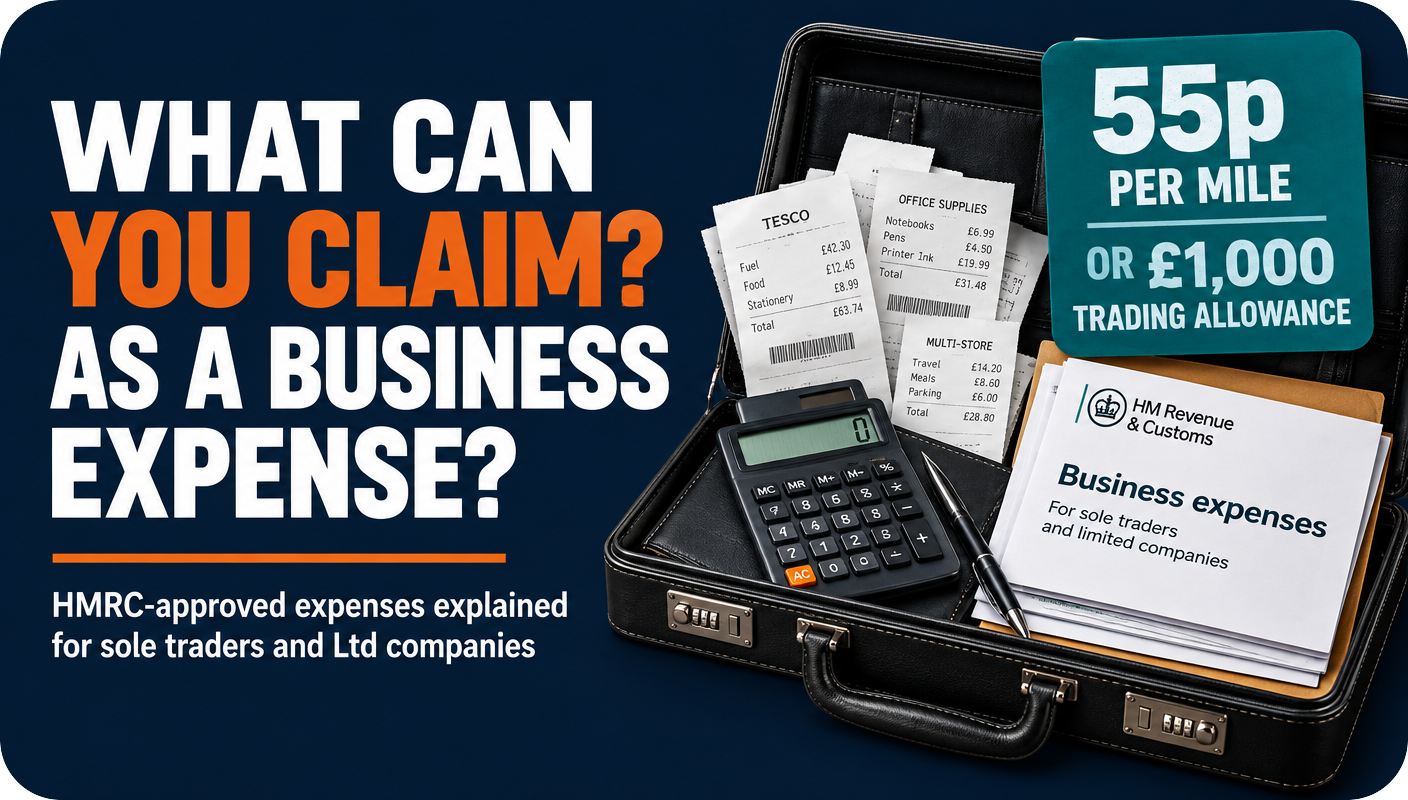
- Sole traders can compare actual costs with simplified expenses. The 2026/27 car rate is 55p for the first 10,000 business miles and 25p thereafter, as of 18 September 2026.
- The £1,000 trading allowance is an alternative to claiming expenses, not something to add on top, as of 18 September 2026.
- Homeworking rules differ: sole traders may use flat rates or a reasonable share of actual costs, while employee tax relief for homeworking is removed from 6 April 2026.
What counts as an allowable business expense?
For a sole trader, an allowable expense reduces taxable profit. For a limited company, a genuine business cost normally reduces the company's taxable profit for Corporation Tax. In both cases, the spending should pass the business purpose test and be recorded accurately.
Common allowable categories include:
- Premises and office costs: rent, business rates, utilities, stationery, postage and reasonable office equipment.
- Phone, internet and software: the business proportion of mixed-use bills, plus software subscriptions used for work.
- Stock and materials: goods bought for resale and materials used to deliver your work.
- Professional costs: accountancy, legal advice, insurance, bank charges and payment processing fees.
- Marketing: website hosting, advertising, design and business promotion.
- Staff and subcontractors: wages, employer costs and genuine subcontractor payments, with the correct payroll or construction industry treatment where relevant.
- Training: courses that update or develop skills used in your existing business. Training for an entirely new trade can be treated differently.
Limited company reminder
Your company is a separate legal person. A company card is not a personal wallet, and money you take for yourself is not automatically an expense. Record director expenses properly and reimburse yourself through the company's records.
Travel, vehicles and mileage
Business journeys can include public transport, reasonable accommodation, parking and congestion or toll charges. Ordinary commuting from home to a permanent workplace is generally private travel, so do not treat it as a business journey simply because you are travelling to work.
For sole traders using simplified expenses, the rates changed during the current period. For journeys from 6 April 2025 to 5 April 2026, cars and goods vehicles use 45p for the first 10,000 business miles and 25p thereafter. For the 2026/27 tax year, the rate is 55p for the first 10,000 miles and 25p thereafter, as of 18 September 2026. Motorcycles are 24p per mile in both periods, as of 18 September 2026.
Keep a mileage log showing the date, destination, purpose and miles. You can claim parking and other qualifying travel costs separately. Once you choose simplified mileage for a vehicle, you normally continue with that method for as long as that vehicle is used in the business.
Do not double claim
Do not claim simplified mileage and then also claim fuel, insurance, repairs and servicing for the same vehicle. Compare simplified mileage with actual costs before choosing, and keep the calculation that supports your decision.
Working from home
A sole trader can claim a reasonable business share of household costs such as heating, electricity, Council Tax, rent or mortgage interest and internet use. Use a sensible calculation based on rooms, floor area and the time spent working, rather than claiming the whole bill.
Alternatively, sole traders working at home for at least 25 hours a month can use simplified expenses. The monthly flat rates are £10 for 25 to 50 hours, £18 for 51 to 100 hours and £26 for 101 or more hours, as of 18 September 2026. These rates do not include telephone or internet, for which you can claim the business proportion of actual costs.
Important employee change
From 6 April 2026, employees cannot claim tax relief from HMRC for unreimbursed homeworking costs. Employers can still reimburse eligible additional costs under the rules. This is separate from a sole trader's business expense claim, so check which category applies to you.
Equipment, computers and larger purchases
Small items used in the business may be ordinary expenses. Larger equipment, machinery and vehicles may instead be dealt with through capital allowances, depending on your accounting method, the asset and how it is used. A mixed-use asset must be split so only the business element is claimed.
Do not assume that buying an expensive item makes the whole amount an immediate expense. Your accountant can check whether capital allowances, annual investment rules or another treatment applies to your circumstances.
Meals, entertainment and clothing
Business entertaining for clients and suppliers is usually not deductible for tax, even if it helps a relationship. Staff entertaining can qualify within the relevant conditions. Business travel may allow reasonable subsistence, but the journey itself must be a qualifying business trip and the cost must be genuine.
Everyday clothes are private, even if you only wear them at work. Uniforms, protective clothing and specialist clothing that is unsuitable for ordinary private wear can be different. Keep the receipt and be clear about why the item is needed.
A simple check before you pay
Ask: "Would I have bought this if I did not run the business?" Then ask: "Can I explain the business purpose in one sentence?" Save the receipt, note the purpose and record any private proportion immediately.
The £1,000 trading allowance
If your gross trading income is £1,000 or less in the tax year, as of 18 September 2026, you may be able to use the tax-free trading allowance rather than calculate actual expenses. If you use the allowance, you cannot also claim your actual business expenses or capital allowances for that trade.
If gross income is above £1,000, you normally calculate taxable profit using actual allowable expenses, although the allowance rules can have specific effects for different circumstances. Compare both methods and keep evidence. The allowance is not a licence to ignore records: you still need to know your income and whether registration or a tax return is required.
Common mistakes to avoid
- Claiming personal spending, drawings or private use as business costs.
- Claiming the full cost of a mixed-use phone, home or vehicle.
- Confusing commuting with business travel.
- Using the £1,000 trading allowance and actual expenses together.
- Forgetting receipts, mileage logs or the reason for a purchase.
- Putting a director's personal purchase through a limited company without considering benefit, loan or payroll treatment.
- Missing the difference between a revenue expense and a capital purchase.
Good bookkeeping services make these decisions easier by keeping the evidence close to each transaction. If you are a sole trader, see our sole trader accounts support. If you operate through a company, our limited company accounts service can help keep expenses, payroll and Corporation Tax aligned.
Questions and answers
Can I claim a business expense without a receipt?
You should keep receipts or other reliable evidence wherever possible. A bank statement proves payment but may not explain what was bought or its business purpose. Reconstruct the record promptly, retain invoices and make a note if an original receipt is unavailable.
Can I claim my home internet and mobile phone?
Yes, claim the business proportion where there is private use. A business-only contract can generally be treated as a business cost, while a mixed contract needs a fair and consistent split. Keep the bills and your calculation.
Can I claim meals when I meet a client?
Client entertaining is generally disallowed for tax, even where the meeting is commercial. Reasonable subsistence while travelling on a qualifying business journey can be different. Staff events and meals have their own rules, so do not label client entertaining as subsistence.
Can I claim mileage if the vehicle is in my own name?
Yes, a sole trader can use the simplified mileage method for a qualifying private vehicle. The 2026/27 car and goods vehicle rates are 55p for the first 10,000 business miles and 25p thereafter, as of 18 September 2026. Keep a complete mileage log and do not claim the same running costs again.
What if my company pays for my personal expense?
Do not assume it is harmless. It may be a director expense, a benefit in kind, a director's loan or a distribution, depending on the facts. Record it promptly and ask your accountant before the year end, especially where tax, National Insurance or reporting may apply.
Should I use actual costs or simplified expenses?
There is no universal winner. Compare the result, time involved and record keeping for your business. Simplified expenses are available to eligible sole traders and partnerships for specified areas, but not to limited companies. Our pricing page explains ways we can help you keep the process proportionate.
Not sure what you can claim?
We help small businesses and sole traders across Guildford, Surrey and beyond turn receipts into clear, compliant records. Get practical advice before a small uncertainty becomes an expensive mistake.
Contact 360 Accounts today