
What Is a Director's Loan? A Plain-English Guide for Ltd Company Directors
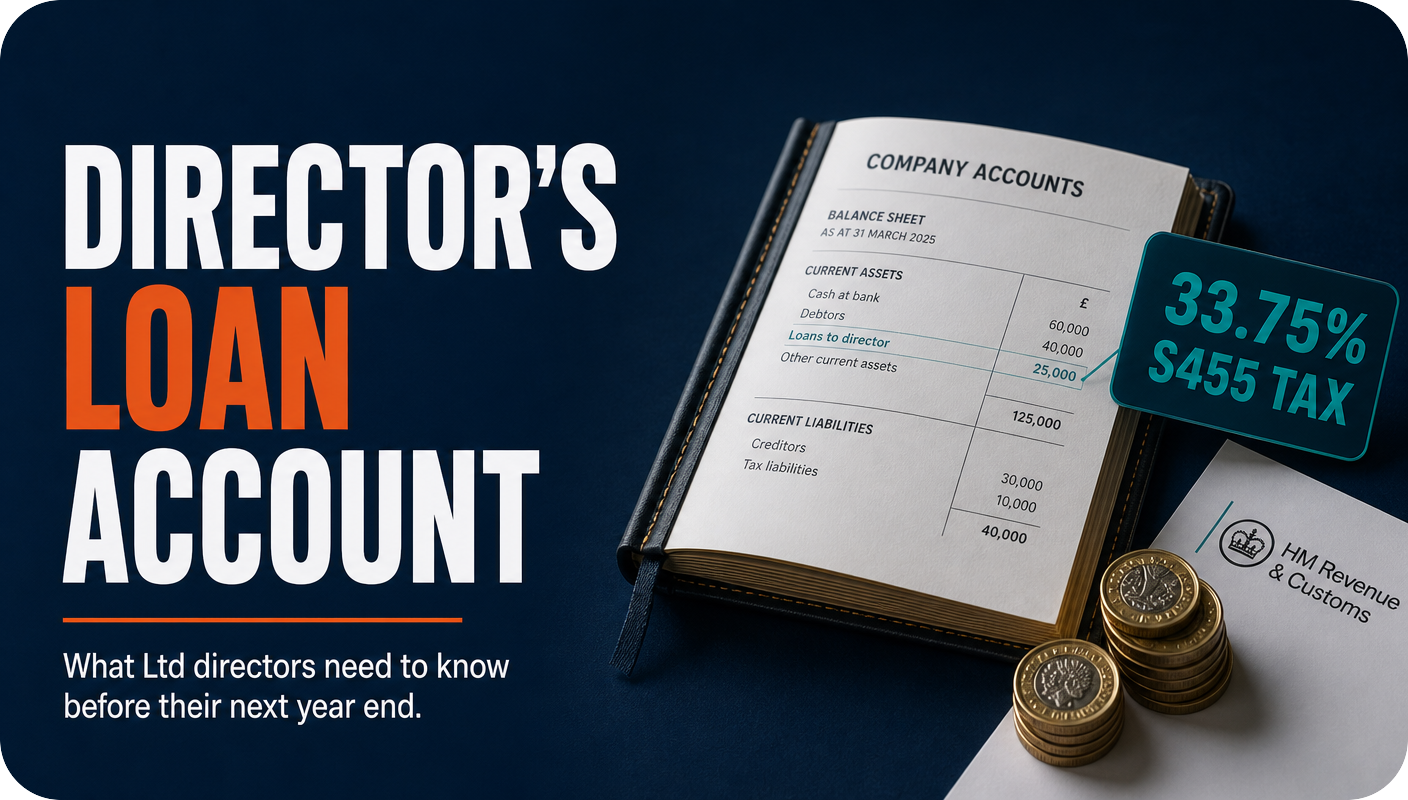
If you run a limited company, there may be times when you take money from the business that isn’t a salary, dividend, or expense repayment. Or perhaps you put your own money in to help cash flow. Both situations create what’s known as a director’s loan — and as of 21 July 2026, getting this wrong can trigger significant tax charges that many directors don’t see coming.
- A director’s loan is any money you take from or lend to your company that isn’t salary, dividends, or reimbursed expenses.
- If you owe the company money at year end and don’t repay within 9 months, the company faces a 33.75% S455 tax charge.
- Loans over £10,000 must be reported to HMRC as a benefit in kind on a P11D form.
- Writing off a director’s loan triggers income tax and potentially National Insurance.
- Good bookkeeping is essential — HMRC scrutinises director’s loan accounts closely.
What Is a Director’s Loan Account?
A Director’s Loan Account (DLA) is simply a record in your company’s accounts that tracks all the money you’ve taken out of or put into the business — outside of your normal salary or dividends. Your accountant or bookkeeper will maintain this as part of your limited company accounts.
The balance can sit in one of two positions:
- Overdrawn DLA — you owe the company money (you’ve taken more out than you’ve put in).
- Credit DLA — the company owes you money (you’ve lent more in than you’ve taken out).
When You Borrow from the Company (Overdrawn DLA)
This is the most common scenario — and the riskiest from a tax perspective. If your DLA is overdrawn at your company’s year end and you haven’t repaid it within 9 months and 1 day, HMRC charges the company an additional Corporation Tax surcharge under S455.
Benefit in Kind: Loans Over £10,000
If your director’s loan exceeds £10,000 at any point during the tax year, HMRC treats it as a benefit in kind. This means:
- You must report it on a P11D form by 6 July following the tax year end.
- You personally pay income tax on the interest HMRC says you should have paid (based on HMRC’s official rate for beneficial loans — currently 2.25% as of 21 July 2026).
- The company pays Class 1A National Insurance on the benefit.
To avoid this, you can charge yourself interest at HMRC’s official rate or above — but this must be documented and paid to the company. Our personal taxation service covers P11D submissions so you don’t miss the deadline.
When You Lend Money to the Company (Credit DLA)
A credit DLA means you’ve put your own money into the business — perhaps to cover a cash flow gap or fund a purchase. This is completely fine and relatively straightforward:
- You can repay yourself at any time — this is tax-free as it is simply returning your own money.
- You can charge the company interest on the loan (up to a commercial rate), which the company can deduct as a business expense — but you must declare this interest as personal income on your Self Assessment return.
Keeping clear records is essential. Our bookkeeping services ensure your DLA is accurately maintained throughout the year.
Can a Director’s Loan Be Written Off?
Yes — but it comes at a cost. If the company formally writes off (waives) an overdrawn DLA, you don’t need to repay the money. However, HMRC treats the written-off amount as:
- A dividend (or income) in your hands — taxable at your marginal rate.
- Potentially subject to Class 1 National Insurance if treated as employment income.
Best Practice for Director’s Loans
- Review your DLA balance regularly — don’t wait until year end.
- Repay any overdrawn balance within 9 months of your company’s year end.
- Keep clear records of every transaction in and out of the DLA.
- If your loan exceeds £10,000, talk to your accountant about P11D obligations promptly.
- Never rely on writing off a loan as a “solution” without understanding the tax implications first.
Getting your director’s loan strategy right is one of the most impactful things an owner-managed company can do to protect its cash. If you’re unsure where your DLA stands, take a look at our limited company accounts service or view our pricing to see how we can help.
Director’s Loans — Your Questions Answered
Q: What counts as a director’s loan?
Any money you take from the company that isn’t a salary, dividend, or reimbursement of a business expense counts as a director’s loan. This includes cash withdrawals, personal bills paid by the company, or personal purchases put through the business account.
Q: What is S455 tax and who pays it?
S455 is a Corporation Tax surcharge paid by the company (not you personally)$when a director’s loan remains overdrawn 9 months and 1 day after the company’s year end. As of 21 July 2026 the rate is 33.75%. It is refundable once the loan is repaid, but the refund is delayed.
Q: What happens if I don’t repay my director’s loan?
The company will owe S455 tax. If the loan is over £10,000, you will also have a personal benefit-in-kind charge reported on a P11D, and the company will owe Class 1A NI. If the loan is written off rather than repaid, you will owe income tax on the amount.
Q: Can I take a director’s loan to pay myself instead of a salary or dividend?
Some directors do this to defer tax, but it must be managed carefully. HMRC is alert to this practice, and the anti-avoidance “bed and breakfasting” rules mean simply recycling a repayment won’t reset the clock. Always discuss this strategy with your accountant first.
Q: Is a credit director’s loan taxable?
No — repaying yourself money you have genuinely lent to the company is tax-free. However, if you charge the company interest on that loan, you must declare the interest as income on your Self Assessment return.
Q: How does 360 Accounts help with director’s loans?
We maintain your director’s loan account as part of your year-end accounts, alert you when balances are approaching tax thresholds, and handle any P11D filings required. Book a free call to find out more.
Worried About Your Director’s Loan Account?
We help Ltd company directors stay on top of their DLA, avoid S455 charges, and structure their pay tax-efficiently. Get in touch today — we’re based in Guildford and work with directors across Surrey and beyond.
Book a Free Call